诃 (hē) means "To scold / To berate" in Chinese. It has 7 strokes with the radical 讠.
Rated 3.2/5 in difficulty (challenging).
Appears in 3+ common words including 诃斥 (hē chì), 诃责 (hē zé), 摩诃 (mó hē).
Due to its 7 strokes, Hanzi Writer's error detection shows 诃 requires focused practice — most learners need 10+ attempts for consistent accuracy.
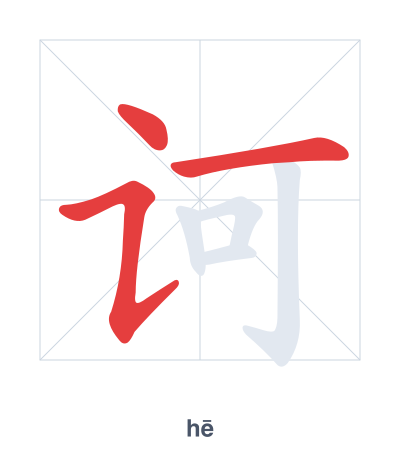
Open Hanzi Writer to see the animated stroke order and practice writing 诃 with real-time feedback.
The character 诃 (hē) is written with 7 strokes. Follow the standard Chinese stroke order: top to bottom, left to right, outside before inside. The radical 讠 is one of its key components.
Practice the correct stroke order with the Hanzi Writer app to see animated stroke-by-stroke guidance with real-time feedback.
诃 means To scold / To berate.
诃 is a phono-semantic compound combining the radical 讠 (speech) with 可 (kě, 'can/able') as a phonetic component. The speech radical indicates the meaning relates to spoken words, while 可 provides the sound, together forming the character for 'to scold' or 'to berate'.
💡 Memory Tip: Picture a speech bubble (讠) with a big open mouth (可) shouting 'Ha!' to scold someone angrily.
老师诃斥了那个学生。
lǎo shī hē chì le nà ge xué shēng
The teacher berated that student.
他受到了严厉的诃责。
tā shòu dào le yán lì de hē zé
He was severely rebuked.
这是一个摩诃萨。
zhè shì yí gè mó hē sà
This is a Mahasattva (a great being in Buddhism).
Open Hanzi Writer to see the animated stroke order and practice writing 诃 with real-time feedback.
✨ Animated stroke order · Handwriting recognition · HSK-graded practice · Free to use
诃 is composed of the radical 讠 (speech) on the left and the phonetic component 可 on the right. The speech radical indicates that the character involves spoken words, while 可 provides pronunciation. Together, they form a character meaning "to scold" or "to berate" – a verbal action.