委 (wēi/wěi) means "To entrust; committee" in Chinese. It has 8 strokes with the radical 女, and is HSK Level 5.
Rated 3.7/5 in difficulty (challenging).
Harder than 32% of HSK Level 5 characters.
Appears in 3+ common words including 委托 (wěi tuō), 委屈 (wěi qū), 委蛇 (wēi yí).
Due to its 8 strokes, Hanzi Writer's error detection shows 委 requires focused practice — most learners need 10+ attempts for consistent accuracy.
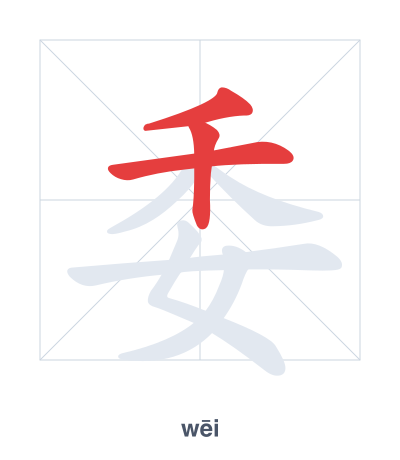
Open Hanzi Writer to see the animated stroke order and practice writing 委 with real-time feedback.
The character 委 (wēi/wěi) is written with 8 strokes. Follow the standard Chinese stroke order: top to bottom, left to right, outside before inside. The radical 女 is one of its key components.
Practice the correct stroke order with the Hanzi Writer app to see animated stroke-by-stroke guidance with real-time feedback.
委 means To entrust; committee.
This is a polyphonic character with readings: wēi, wěi.
As an HSK Level 5 character, 委 is an intermediate-level character.
委 combines 禾 (grain) on top and 女 (woman) below, originally depicting a woman bending to gather grain—an act of submission or careful handling, which extended to mean 'to entrust' something to someone's care, and later 'a committee' as a group entrusted with tasks.
💡 Memory Tip: Picture a woman (女) bowing under a heavy sheaf of grain (禾), entrusted with the task of bringing in the harvest for the whole village.
他委托律师全权处理这起经济纠纷案件。
tā wěi tuō lǜ shī quán quán chǔ lǐ zhè qǐ jīng jì jiū fēn àn jiàn
He authorized a lawyer to handle this economic dispute case with full authority.
听了爸爸的误解,他感到心里非常委屈。
tīng le bà bà de wù jiě tā gǎn dào xīn lǐ fēi cháng wěi qū
He felt very wronged after being misunderstood by his father.
面对这种复杂的场面,他不得不与其委蛇一番。
miàn duì zhè zhǒng fù zá de chǎng miàn tā bù dé bù yǔ qí wēi yí yī fān
Facing such a complex situation, he had to deal with them perfunctorily.
Open Hanzi Writer to see the animated stroke order and practice writing 委 with real-time feedback.
✨ Animated stroke order · Handwriting recognition · HSK-graded practice · Free to use
委 combines the radical 女 (woman) on top and 禾 (grain/rice) below. The original idea was a woman bending over to gather grain, which evolved into the concept of "to entrust" or "to commission" — like handing over a task. The radical 女 hints at a person, while 禾 suggests something being carried or managed.