丧 (sāng/sàng) means "funeral; mourning; to lose" in Chinese. It has 8 strokes with the radical 一, and is HSK Level 6.
Rated 3.4/5 in difficulty (challenging).
Harder than 14% of HSK Level 6 characters.
Appears in 3+ common words including 丧失 (sàng shī), 沮丧 (jǔ sàng), 丧事 (sāng shì).
Due to its 8 strokes, Hanzi Writer's error detection shows 丧 requires focused practice — most learners need 10+ attempts for consistent accuracy.
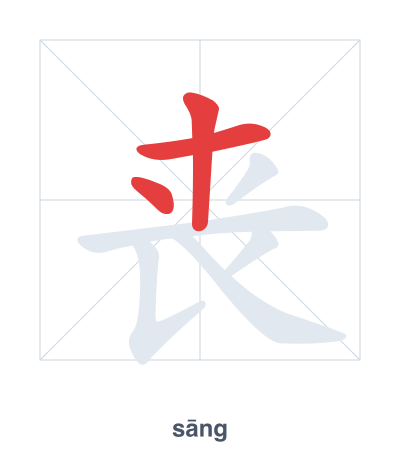
Open Hanzi Writer to see the animated stroke order and practice writing 丧 with real-time feedback.
The character 丧 (sāng/sàng) is written with 8 strokes. Follow the standard Chinese stroke order: top to bottom, left to right, outside before inside. The radical 一 is one of its key components.
Practice the correct stroke order with the Hanzi Writer app to see animated stroke-by-stroke guidance with real-time feedback.
丧 means funeral; mourning; to lose.
This is a polyphonic character with readings: sāng, sàng.
As an HSK Level 6 character, 丧 is an intermediate-level character.
The character 丧 originally depicted a person mourning, with a crying mouth (口) and a bent body, symbolizing grief and loss. Over time, it evolved into a compound where the top part (十 with two dots) represents a funeral banner or ritual object, and the bottom 口 (mouth) signifies weeping. The component 亡 (to lose/death) is also implied in the structure, linking to the meaning of 'funeral' or 'to lose.'
💡 Memory Tip: Imagine a funeral where a cross-shaped wreath (十) covers the crying mouth (口) of a mourner whose body is bent (乚) in sorrow.
他丧失了信心。
tā sàng shī le xìn xīn
He lost his confidence.
别为这事感到沮丧。
bié wèi zhè shì gǎn dào jǔ sàng
Don't feel frustrated about this.
他家正在办丧事。
tā jiā zhèng zài bàn sāng shì
His family is currently holding a funeral.
Open Hanzi Writer to see the animated stroke order and practice writing 丧 with real-time feedback.
✨ Animated stroke order · Handwriting recognition · HSK-graded practice · Free to use
The character 丧 combines the radical 一 (one) on top with 丷 (a variant of eight) and 长 (long) below, but this is a simplified structural breakdown. Historically, its components suggest the idea of losing something important, which connects to its meanings of 'funeral' and 'to lose'.