奶 (nǎi) means "milk; grandmother" in Chinese. It has 5 strokes with the radical 女, and is HSK Level 1.
Rated 2.4/5 in difficulty (moderate).
Harder than 31% of HSK Level 1 characters.
Appears in 3+ common words including 牛奶 (niú nǎi), 奶奶 (nǎi nǎi), 酸奶 (suān nǎi).
Hanzi Writer's stroke validation shows learners typically need 5-8 attempts to write 奶 with correct proportion and order.
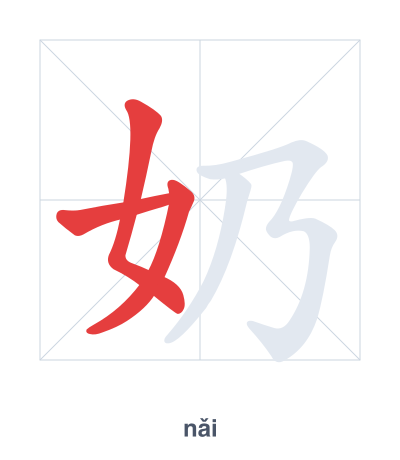
Open Hanzi Writer to see the animated stroke order and practice writing 奶 with real-time feedback.
The character 奶 (nǎi) is written with 5 strokes. Follow the standard Chinese stroke order: top to bottom, left to right, outside before inside. The radical 女 is one of its key components.
Practice the correct stroke order with the Hanzi Writer app to see animated stroke-by-stroke guidance with real-time feedback.
奶 means milk; grandmother.
As an HSK Level 1 character, 奶 is among the first characters beginners learn.
奶 combines the radical 女 (woman) with 乃 (phonetic, also anciently depicting a curved breast shape), originally referring to breast milk. Over time, its meaning expanded to include 'milk' in general, and as a term of endearment for older female relatives like grandmother.
💡 Memory Tip: Picture a woman (女) with a curved arm shaped like the character 乃, gently holding a bottle of milk.
我喜欢喝牛奶。
wǒ xǐ huān hē niú nǎi
I like drinking milk.
奶奶在做饭。
nǎi nǎi zài zuò fàn
Grandma is cooking.
冰箱里有酸奶。
bīng xiāng lǐ yǒu suān nǎi
There is yogurt in the fridge.
Open Hanzi Writer to see the animated stroke order and practice writing 奶 with real-time feedback.
✨ Animated stroke order · Handwriting recognition · HSK-graded practice · Free to use
奶 is made of two parts: the left part 女 (woman) and the right part 乃 (nǎi, a sound component). The 女 radical hints that the character relates to women, which connects to grandmother (a female elder) and breast milk. The 乃 part gives the pronunciation, like in 牛奶 (niú nǎi, milk).