奸 (jiān) means "Treacherous / Evil" in Chinese. It has 6 strokes with the radical 女, and is HSK Level 7.
Rated 3.2/5 in difficulty (challenging).
Harder than 10% of HSK Level 7 characters.
Appears in 3+ common words including 奸商 (jiān shāng), 奸笑 (jiān xiào), 奸细 (jiān xì).
Due to its 6 strokes, Hanzi Writer's error detection shows 奸 requires focused practice — most learners need 10+ attempts for consistent accuracy.
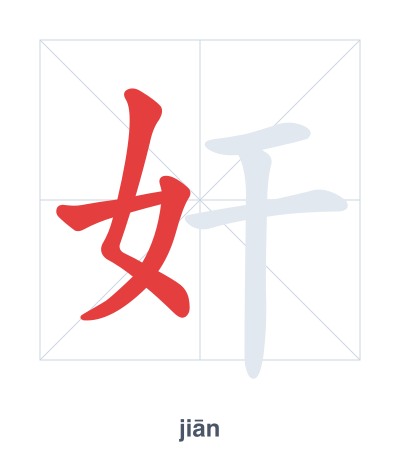
Open Hanzi Writer to see the animated stroke order and practice writing 奸 with real-time feedback.
The character 奸 (jiān) is written with 6 strokes. Follow the standard Chinese stroke order: top to bottom, left to right, outside before inside. The radical 女 is one of its key components.
Practice the correct stroke order with the Hanzi Writer app to see animated stroke-by-stroke guidance with real-time feedback.
奸 means Treacherous / Evil.
As an HSK Level 7 character, 奸 is an intermediate-level character.
The character 奸 combines the radical 女 (woman) with 干 (gān, meaning 'to offend' or 'shield'). In ancient usage, it originally referred to adultery or illicit relations, later extending to mean treacherous or evil, as the woman radical often carried a negative connotation in such compound characters.
💡 Memory Tip: A treacherous woman (女) uses a shield (干) to hide her evil deeds.
他是一个奸商。
tā shì yí gè jiān shāng
He is an unscrupulous merchant.
他发出了奸笑。
tā fā chū le jiān xiào
He gave a sinister laugh.
谁是奸细?
shuí shì jiān xì
Who is the spy?
Open Hanzi Writer to see the animated stroke order and practice writing 奸 with real-time feedback.
✨ Animated stroke order · Handwriting recognition · HSK-graded practice · Free to use
奸 is composed of the radical 女 (woman) on the left and the component 干 (gān, meaning "dry" or "to do") on the right. Together, they suggest a woman doing something improper, which relates to the meaning "treacherous" or "evil." This is a structural analysis, not a historical etymology.