乳 (rǔ) means "milk or breast" in Chinese. It has 8 strokes with the radical 乙, and is HSK Level 6.
Rated 3.4/5 in difficulty (challenging).
Harder than 14% of HSK Level 6 characters.
Appears in 3+ common words including 乳酪 (rǔ lào), 母乳 (mǔ rǔ), 乳液 (rǔ yè).
Due to its 8 strokes, Hanzi Writer's error detection shows 乳 requires focused practice — most learners need 10+ attempts for consistent accuracy.
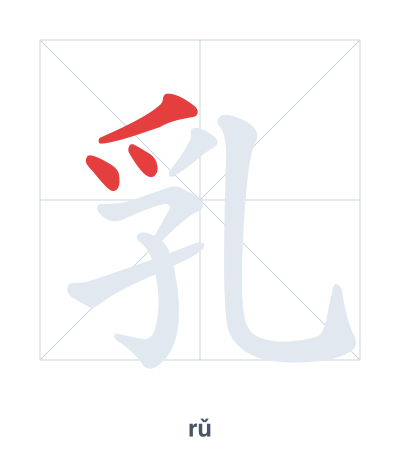
Open Hanzi Writer to see the animated stroke order and practice writing 乳 with real-time feedback.
The character 乳 (rǔ) is written with 8 strokes. Follow the standard Chinese stroke order: top to bottom, left to right, outside before inside. The radical 乙 is one of its key components.
Practice the correct stroke order with the Hanzi Writer app to see animated stroke-by-stroke guidance with real-time feedback.
乳 means milk or breast.
As an HSK Level 6 character, 乳 is an intermediate-level character.
In ancient oracle bone script, 乳 depicted a mother kneeling and holding a baby to her breast, with droplets of milk. The modern form combines 爪 (a hand) over 子 (child) on the left, and 乙 (a curved line) on the right, representing the breast or milk flow.
💡 Memory Tip: Picture a hand (爪) cradling a baby (子) while a squiggly stream of milk (乙) shoots into its mouth.
我喜欢吃乳酪。
wǒ xǐ huān chī rǔ lào
I like eating cheese.
宝宝喝母乳。
bǎo bǎo hē mǔ rǔ
The baby drinks breast milk.
这是护肤乳液。
zhè shì hù fū rǔ yè
This is skin lotion.
Open Hanzi Writer to see the animated stroke order and practice writing 乳 with real-time feedback.
✨ Animated stroke order · Handwriting recognition · HSK-graded practice · Free to use
乳 consists of 爫 on top, which represents a hand or claw, and 乚 at the bottom, which suggests a bent shape like a breast or a milking action. Together, they depict a hand pressing or drawing milk from the breast, giving the character its meaning of milk or breast.