屈 (qū) means "to bend; to yield; injustice" in Chinese. It has 8 strokes with the radical 尸, and is HSK Level 7.
Rated 3.7/5 in difficulty (challenging).
Harder than 24% of HSK Level 7 characters.
Appears in 3+ common words including 委屈 (wěi qū), 屈服 (qū fú), 屈指可数 (qū zhǐ kě shǔ).
Due to its 8 strokes, Hanzi Writer's error detection shows 屈 requires focused practice — most learners need 10+ attempts for consistent accuracy.
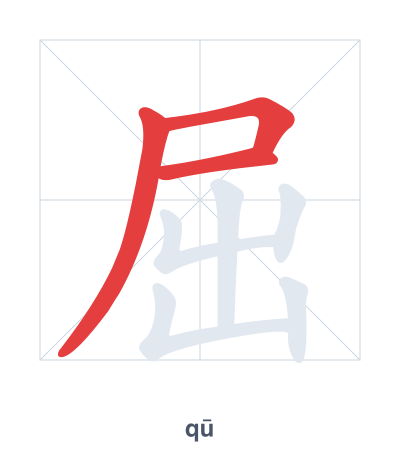
Open Hanzi Writer to see the animated stroke order and practice writing 屈 with real-time feedback.
The character 屈 (qū) is written with 8 strokes. Follow the standard Chinese stroke order: top to bottom, left to right, outside before inside. The radical 尸 is one of its key components.
Practice the correct stroke order with the Hanzi Writer app to see animated stroke-by-stroke guidance with real-time feedback.
屈 means to bend; to yield; injustice.
As an HSK Level 7 character, 屈 is an intermediate-level character.
屈 combines 尸 (body) and 出 (to go out), originally depicting a body bending low to pass through a small opening. This physical act of bending led to the extended meanings of yielding or suffering injustice, like being forced into a humbling posture.
💡 Memory Tip: A corpse (尸) forced to crawl out (出) a narrow exit—bending in humiliation and injustice.
她觉得很委屈。
tā jué de hěn wěi qū
She feels very wronged.
他不会屈服的。
tā bú huì qū fú de
He will not give in.
好机会屈指可数。
hǎo jī huì qū zhǐ kě shǔ
Good opportunities are few and far between.
Open Hanzi Writer to see the animated stroke order and practice writing 屈 with real-time feedback.
✨ Animated stroke order · Handwriting recognition · HSK-graded practice · Free to use
The character 屈 consists of the radical 尸 (corpse or body) on top and 出 (to go out) below. Together, they suggest the body being forced to go out or bend down, linking to the meanings of bending, yielding, or suffering injustice.