妃 (fēi) means "imperial concubine; consort" in Chinese. It has 6 strokes with the radical 女.
Rated 3.2/5 in difficulty (challenging).
Appears in 3+ common words including 王妃 (wáng fēi), 贵妃 (guì fēi), 妃子 (fēi zǐ).
Due to its 6 strokes, Hanzi Writer's error detection shows 妃 requires focused practice — most learners need 10+ attempts for consistent accuracy.
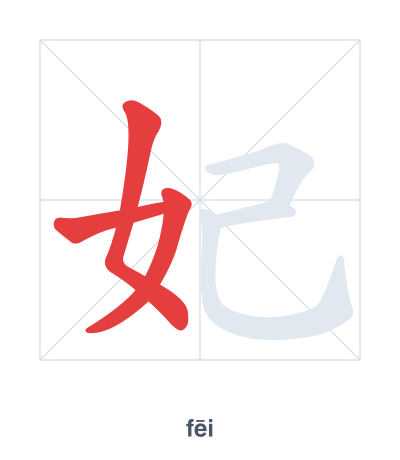
Open Hanzi Writer to see the animated stroke order and practice writing 妃 with real-time feedback.
The character 妃 (fēi) is written with 6 strokes. Follow the standard Chinese stroke order: top to bottom, left to right, outside before inside. The radical 女 is one of its key components.
Practice the correct stroke order with the Hanzi Writer app to see animated stroke-by-stroke guidance with real-time feedback.
妃 means imperial concubine; consort.
妃 combines the radical 女 (woman) with 己 (self), suggesting a woman who 'belongs to oneself'—originally a spouse, later specialized to mean an imperial concubine or consort.
💡 Memory Tip: Imagine a woman (女) wearing a crown made of the letter 'S' (like 己) to show she is a royal consort.
她是一位王妃。
tā shì yī wèi wáng fēi
She is a princess.
杨贵妃很有名。
yáng guì fēi hěn yǒu míng
Consort Yang is very famous.
皇帝有很多妃子。
huáng dì yǒu hěn duō fēi zǐ
The Emperor has many concubines.
Open Hanzi Writer to see the animated stroke order and practice writing 妃 with real-time feedback.
✨ Animated stroke order · Handwriting recognition · HSK-graded practice · Free to use
妃 combines the radical 女 (woman) on the left with 己 (self) on the right. The 女 radical shows the character relates to a woman, while 己 gives the sound and hints at the idea of someone belonging to the emperor, like a consort.