奴 (nú) means "slave; servant" in Chinese. It has 5 strokes with the radical 女, and is HSK Level 7.
Rated 2.9/5 in difficulty (moderate).
Harder than 6% of HSK Level 7 characters.
Appears in 3+ common words including 奴隶 (nú lì), 守财奴 (shǒu cái nú), 奴才 (nú cái).
Hanzi Writer's stroke validation shows learners typically need 5-8 attempts to write 奴 with correct proportion and order.
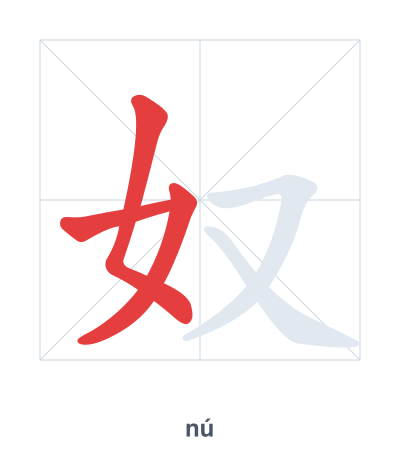
Open Hanzi Writer to see the animated stroke order and practice writing 奴 with real-time feedback.
The character 奴 (nú) is written with 5 strokes. Follow the standard Chinese stroke order: top to bottom, left to right, outside before inside. The radical 女 is one of its key components.
Practice the correct stroke order with the Hanzi Writer app to see animated stroke-by-stroke guidance with real-time feedback.
奴 means slave; servant.
As an HSK Level 7 character, 奴 is an intermediate-level character.
奴 combines 女 (woman) and 又 (hand), symbolizing a woman seized or controlled by a hand, reflecting the role of a female servant or slave in ancient society.
💡 Memory Tip: Picture a woman (女) being grabbed by a hand (又) to force her into slavery.
他不想当奴隶。
tā bù xiǎng dāng nú lì
He doesn't want to be a slave.
他是个守财奴。
tā shì gè shǒu cái nú
He is a miser.
电影里有奴才。
diàn yǐng lǐ yǒu nú cái
There are servants in the movie.
Open Hanzi Writer to see the animated stroke order and practice writing 奴 with real-time feedback.
✨ Animated stroke order · Handwriting recognition · HSK-graded practice · Free to use
奴 is composed of the radical 女 (woman) on the left and the component 又 (right hand) on the right. The woman radical suggests a female slave or servant, while 又 represents a hand controlling or holding someone, visually indicating a person under another's control. Together they create the idea of a slave or servant.