妁 (shuò) means "matchmaker" in Chinese. It has 6 strokes with the radical 女.
Rated 3.2/5 in difficulty (challenging).
Appears in 3+ common words including 媒妁 (méi shuò), 媒妁之言 (méi shuò zhī yán), 妁 (shuò).
Due to its 6 strokes, Hanzi Writer's error detection shows 妁 requires focused practice — most learners need 10+ attempts for consistent accuracy.
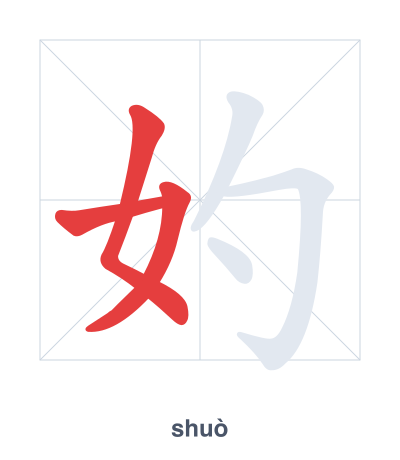
Open Hanzi Writer to see the animated stroke order and practice writing 妁 with real-time feedback.
The character 妁 (shuò) is written with 6 strokes. Follow the standard Chinese stroke order: top to bottom, left to right, outside before inside. The radical 女 is one of its key components.
Practice the correct stroke order with the Hanzi Writer app to see animated stroke-by-stroke guidance with real-time feedback.
妁 means matchmaker.
This compound character combines the radical 女 (woman) with the phonetic component 勺 (spoon). A matchmaker was traditionally a woman who 'stirred' or 'mixed' potential couples together, just as a spoon blends ingredients.
💡 Memory Tip: Picture a woman (女) using a giant spoon (勺) to stir two hearts together into a perfect match.
古代结婚靠媒妁。
gǔ dài jié hūn kào méi shuò
In ancient times, marriage relied on matchmakers.
他听从媒妁之言。
tā tīng cóng méi shuò zhī yán
He followed the advice of the matchmaker.
妁是指媒人。
shuò shì zhǐ méi rén
'Shuo' refers to a matchmaker.
Open Hanzi Writer to see the animated stroke order and practice writing 妁 with real-time feedback.
✨ Animated stroke order · Handwriting recognition · HSK-graded practice · Free to use
The character 妁 is composed of the radical 女 (woman) on the left and the phonetic component 勺 (spoon) on the right. The radical 女 connects to the idea of a matchmaker, who was often a woman in traditional Chinese society. The right side 勺 gives a hint to the pronunciation (shuò) but does not directly relate to meaning.