乖 (guāi) means "well-behaved; obedient; clever" in Chinese. It has 8 strokes with the radical 丿, and is HSK Level 7.
Rated 3.4/5 in difficulty (challenging).
Harder than 12% of HSK Level 7 characters.
Appears in 3+ common words including 乖乖 (guāi guāi), 乖巧 (guāi qiǎo), 乖孩子 (guāi hái zi).
Due to its 8 strokes, Hanzi Writer's error detection shows 乖 requires focused practice — most learners need 10+ attempts for consistent accuracy.
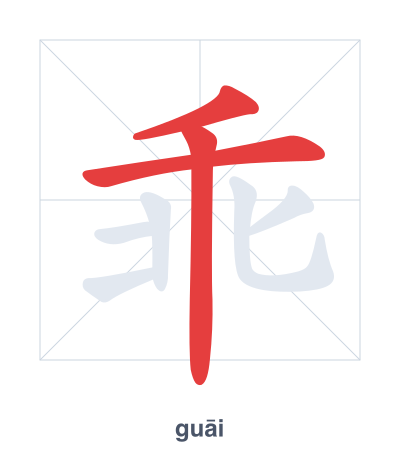
Open Hanzi Writer to see the animated stroke order and practice writing 乖 with real-time feedback.
The character 乖 (guāi) is written with 8 strokes. Follow the standard Chinese stroke order: top to bottom, left to right, outside before inside. The radical 丿 is one of its key components.
Practice the correct stroke order with the Hanzi Writer app to see animated stroke-by-stroke guidance with real-time feedback.
乖 means well-behaved; obedient; clever.
As an HSK Level 7 character, 乖 is an intermediate-level character.
The character 乖 originally depicted two people facing away from each other (北), symbolizing opposition or disobedience. Over time, the meaning reversed to 'well-behaved' and 'obedient', possibly through a semantic shift. The modern form also includes a top stroke (丿) that may represent a turning point.
💡 Memory Tip: Picture a well-behaved child (千) sitting quietly with arms folded (北) facing north, perfectly obedient.
孩子在乖乖睡觉。
hái zi zài guāi guāi shuì jiào
The child is sleeping soundly.
这个小猫很乖巧。
zhè ge xiǎo māo hěn guāi qiǎo
This kitten is very well-behaved and clever.
他在家一直是个听话的乖孩子。
tā zài jiā yì zhí shì gè tīng huà de guāi hái zi 。
He has always been an obedient and well-behaved child at home.
Open Hanzi Writer to see the animated stroke order and practice writing 乖 with real-time feedback.
✨ Animated stroke order · Handwriting recognition · HSK-graded practice · Free to use
乖 is made of a top part resembling 千 (qiān, thousand) and a bottom part resembling 北 (běi, north). The combination suggests someone who follows directions (north) many times (thousand) — hence the meaning "well-behaved" or "obedient." This structural analysis helps explain the character's idea of compliance.