妄 (wàng) means "rash; absurd; wild" in Chinese. It has 6 strokes with the radical 女, and is HSK Level 7.
Rated 3.2/5 in difficulty (challenging).
Harder than 10% of HSK Level 7 characters.
Appears in 3+ common words including 狂妄 (kuáng wàng), 妄想 (wàng xiǎng), 妄下结论 (wàng xià jié lùn).
Due to its 6 strokes, Hanzi Writer's error detection shows 妄 requires focused practice — most learners need 10+ attempts for consistent accuracy.
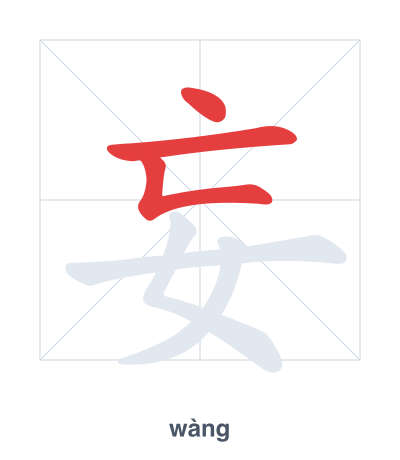
Open Hanzi Writer to see the animated stroke order and practice writing 妄 with real-time feedback.
The character 妄 (wàng) is written with 6 strokes. Follow the standard Chinese stroke order: top to bottom, left to right, outside before inside. The radical 女 is one of its key components.
Practice the correct stroke order with the Hanzi Writer app to see animated stroke-by-stroke guidance with real-time feedback.
妄 means rash; absurd; wild.
As an HSK Level 7 character, 妄 is an intermediate-level character.
妄 is a compound character with the radical 女 (woman) and the phonetic component 亡 (wáng, meaning 'to die' or 'to lose'). It originally depicted a woman who has lost her reason or judgment, thus conveying the meanings 'rash', 'absurd', or 'wild'.
💡 Memory Tip: Picture a woman (女) who has lost (亡) her senses, running around wildly doing absurd things.
他说话很狂妄。
tā shuō huà hěn kuáng wàng
He speaks very arrogantly.
别再妄想了。
bié zài wàng xiǎng le
Stop having delusions.
不要妄下结论。
bú yào wàng xià jié lùn
Don't jump to conclusions.
Open Hanzi Writer to see the animated stroke order and practice writing 妄 with real-time feedback.
✨ Animated stroke order · Handwriting recognition · HSK-graded practice · Free to use
妄 combines the radical 女 (woman) on top and 亡 (wáng, meaning 'die' or 'lose') below. Together, they suggest a woman who is lost or disconnected from reason, giving the meanings of being rash or absurd.