填 (tián) means "to fill in" in Chinese. It has 13 strokes with the radical 土, and is HSK Level 4.
Rated 4.2/5 in difficulty (advanced).
Harder than 66% of HSK Level 4 characters.
Appears in 3+ common words including 填写 (tián xiě), 填空 (tián kòng), 填满 (tián mǎn).
Due to its 13 strokes, Hanzi Writer's error detection shows 填 requires focused practice — most learners need 10+ attempts for consistent accuracy.
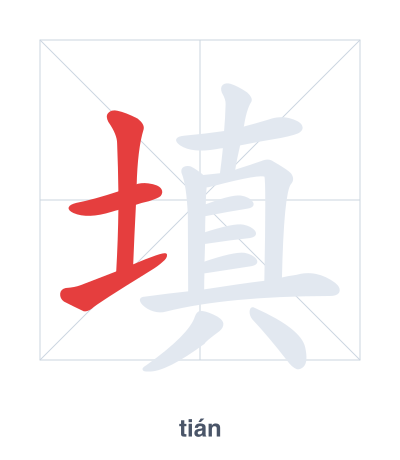
Open Hanzi Writer to see the animated stroke order and practice writing 填 with real-time feedback.
The character 填 (tián) is written with 13 strokes. Follow the standard Chinese stroke order: top to bottom, left to right, outside before inside. The radical 土 is one of its key components.
Practice the correct stroke order with the Hanzi Writer app to see animated stroke-by-stroke guidance with real-time feedback.
填 means to fill in.
As an HSK Level 4 character, 填 is an intermediate-level character.
填 is a compound character with the radical 土 (earth/soil) indicating the action involves dirt, and the phonetic component 真 (zhēn, meaning 'true' or 'real'). In ancient times, filling a hole or leveling ground required adding real earth to make it solid, so the character visually combines 'earth' with 'true' to convey 'filling in' with genuine soil.
💡 Memory Tip: To fill in a hole, you need true (真) earth (土), so imagine packing real dirt into a gap until it's perfectly level.
请填写这张表。
qǐng tián xiě zhè zhāng biǎo
Please fill out this form.
这是一个填空题。
zhè shì yí gè tián kòng tí
This is a fill-in-the-blank question.
把杯子填满水。
bǎ bēi zi tián mǎn shuǐ
Fill the cup with water.
Open Hanzi Writer to see the animated stroke order and practice writing 填 with real-time feedback.
✨ Animated stroke order · Handwriting recognition · HSK-graded practice · Free to use
填 consists of the radical 土 (earth) on the left and 真 (true/real) on the right. The earth radical suggests filling or covering with soil, while 真 hints that the action makes something complete or solid. Together, they convey the idea of filling a space to make it whole.