埝 (niàn) means "Bank; dike; low wall." in Chinese. It has 11 strokes with the radical 土.
Rated 4.2/5 in difficulty (advanced).
Appears in 3+ common words including 土埝 (tǔ niàn), 埝子 (niàn zi), 筑埝 (zhù niàn).
Due to its 11 strokes, Hanzi Writer's error detection shows 埝 requires focused practice — most learners need 10+ attempts for consistent accuracy.
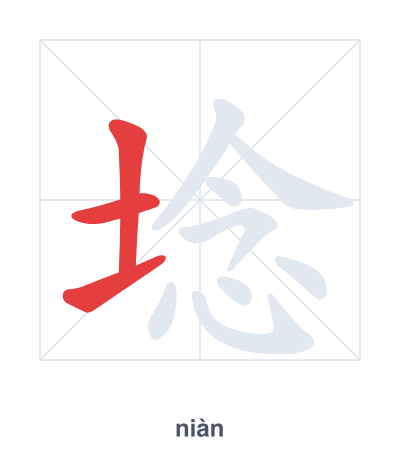
Open Hanzi Writer to see the animated stroke order and practice writing 埝 with real-time feedback.
The character 埝 (niàn) is written with 11 strokes. Follow the standard Chinese stroke order: top to bottom, left to right, outside before inside. The radical 土 is one of its key components.
Practice the correct stroke order with the Hanzi Writer app to see animated stroke-by-stroke guidance with real-time feedback.
埝 means Bank; dike; low wall..
埝 is a phono-semantic compound: the radical 土 (earth) indicates an embankment made of soil, while 念 (niàn) provides the pronunciation. It refers to a low earth wall or dike used to hold back water or mark a boundary.
💡 Memory Tip: Picture a person lost in thought (念) perched on a low bank of earth (土) by a river.
路上有一个土埝。
lù shàng yǒu yí gè tǔ niàn
There is an earthen bank on the road.
坐在埝子上休息。
zuò zài niàn zi shàng xiū xī
Sitting on the earth bank to rest.
工人们在筑埝。
gōng rén men zài zhù niàn
Workers are building a low dike.
Open Hanzi Writer to see the animated stroke order and practice writing 埝 with real-time feedback.
✨ Animated stroke order · Handwriting recognition · HSK-graded practice · Free to use
埝 is composed of the radical 土 (earth) on the left, and the phonetic component 念 (niàn, to read aloud or think) on the right. The earth radical directly relates to the meaning of a bank or dike made of soil, while 念 provides the pronunciation hint.