埠 (bù) means "Port; wharf; trading city." in Chinese. It has 11 strokes with the radical 土.
Rated 4.2/5 in difficulty (advanced).
Appears in 3+ common words including 商埠 (shāng bù), 埠头 (bù tóu), 本埠 (běn bù).
Due to its 11 strokes, Hanzi Writer's error detection shows 埠 requires focused practice — most learners need 10+ attempts for consistent accuracy.
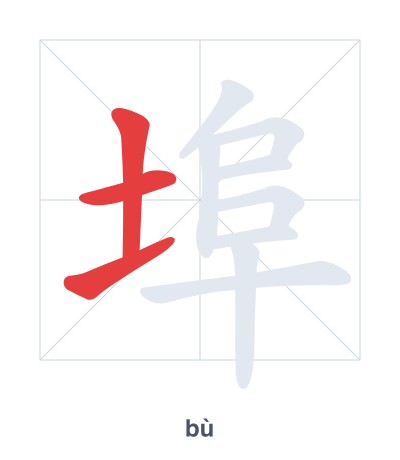
Open Hanzi Writer to see the animated stroke order and practice writing 埠 with real-time feedback.
The character 埠 (bù) is written with 11 strokes. Follow the standard Chinese stroke order: top to bottom, left to right, outside before inside. The radical 土 is one of its key components.
Practice the correct stroke order with the Hanzi Writer app to see animated stroke-by-stroke guidance with real-time feedback.
埠 means Port; wharf; trading city..
The character 埠 combines the radical 土 (earth) with 阜 (a mound or hill), originally depicting a built-up earth embankment along a riverbank used for docking boats. The left side signifies the ground or construction material, while the right side suggests the raised, stepped terrain typical of a wharf or trading port.
💡 Memory Tip: Picture a port where a mound of earth (土) has steps (the shape of 阜) leading down to the water for loading and unloading cargo.
这个城市是一个商埠。
zhè ge chéng shì shì yí gè shāng bù
This city is a commercial port.
船停靠在埠头。
chuán tíng kào zài bù tóu
The boat is docked at the pier.
本埠邮费比较便宜。
běn bù yóu fèi bǐ jiào pián yi
Local postage is cheaper.
Open Hanzi Writer to see the animated stroke order and practice writing 埠 with real-time feedback.
✨ Animated stroke order · Handwriting recognition · HSK-graded practice · Free to use
埠 is made of two parts: the left side 土 (earth) and the right side 阜 (a mound or hill). The 土 radical suggests a place built on land, while 阜 adds the idea of a raised area near water, together forming the concept of a port or wharf.