课 (kè) means "Lesson; class" in Chinese. It has 10 strokes with the radical 讠, and is HSK Level 1.
Rated 3.4/5 in difficulty (challenging).
Harder than 75% of HSK Level 1 characters.
Appears in 3+ common words including 上课 (shàng kè), 课本 (kè běn), 功课 (gōng kè).
Due to its 10 strokes, Hanzi Writer's error detection shows 课 requires focused practice — most learners need 10+ attempts for consistent accuracy.
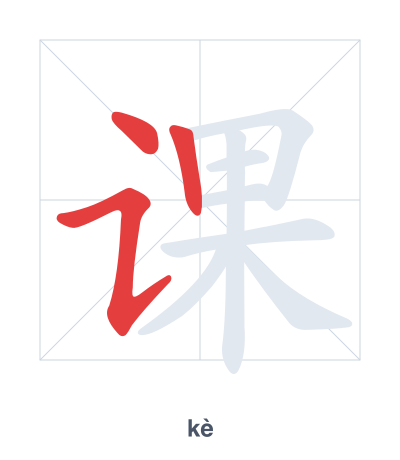
Open Hanzi Writer to see the animated stroke order and practice writing 课 with real-time feedback.
The character 课 (kè) is written with 10 strokes. Follow the standard Chinese stroke order: top to bottom, left to right, outside before inside. The radical 讠 is one of its key components.
Practice the correct stroke order with the Hanzi Writer app to see animated stroke-by-stroke guidance with real-time feedback.
课 means Lesson; class.
As an HSK Level 1 character, 课 is among the first characters beginners learn.
课 combines the speech radical 讠 (words/talk) with 果 (fruit/result), originally meaning to assess or test someone's knowledge, like checking the 'fruits' of learning. Over time it came to mean a lesson or class, where speech is used to teach and evaluate.
💡 Memory Tip: A teacher talks (讠) about a fruit (果) tree, and that's your lesson for today.
我们现在开始上课。
wǒ men xiàn zài kāi shǐ shàng kè
Let's start the class now.
请打开你的课本。
qǐng dǎ kāi nǐ de kè běn
Please open your textbook.
你做完功课了吗?
nǐ zuò wán gōng kè le ma
Have you finished your homework?
Open Hanzi Writer to see the animated stroke order and practice writing 课 with real-time feedback.
✨ Animated stroke order · Handwriting recognition · HSK-graded practice · Free to use
课 consists of the radical 讠 (speech) on the left and the phonetic component 果 (guǒ, fruit) on the right. The radical 讠 indicates that the character relates to words or speech, while 果 provides pronunciation. Together, they form the meaning 'lesson' or 'class,' as a lesson is a spoken or written instruction that bears fruit in learning.