迎 (yíng) means "to welcome; to meet" in Chinese. It has 7 strokes with the radical 辶, and is HSK Level 2.
Rated 2.9/5 in difficulty (moderate).
Harder than 41% of HSK Level 2 characters.
Appears in 3+ common words including 欢迎 (huān yíng), 迎接 (yíng jiē), 迎面 (yíng miàn).
Hanzi Writer's stroke validation shows learners typically need 5-8 attempts to write 迎 with correct proportion and order.
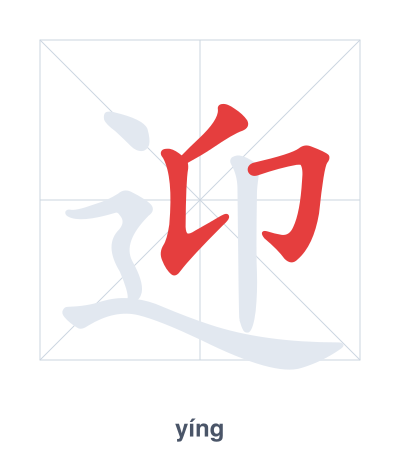
Open Hanzi Writer to see the animated stroke order and practice writing 迎 with real-time feedback.
The character 迎 (yíng) is written with 7 strokes. Follow the standard Chinese stroke order: top to bottom, left to right, outside before inside. The radical 辶 is one of its key components.
Practice the correct stroke order with the Hanzi Writer app to see animated stroke-by-stroke guidance with real-time feedback.
迎 means to welcome; to meet.
As an HSK Level 2 character, 迎 is among the first characters beginners learn.
迎 combines the radical 辶 (movement, walking) with 卬, an ancient pictograph of a kneeling person raising both hands to greet or meet someone. Together, they depict the action of moving forward to welcome a visitor with open hands.
💡 Memory Tip: Imagine a person (卬) walking on the road (辶) with arms outstretched to warmly welcome an arriving friend.
欢迎大家来中国旅游。
huān yíng dà jiā lái zhōng guó lǚ yóu
Welcome everyone to travel to China.
我们去机场迎接客人。
wǒ men qù jī chǎng yíng jiē kè rén
Let's go to the airport to meet the guests.
他迎面走过来。
tā yíng miàn zǒu guò lái
He came walking toward me.
Open Hanzi Writer to see the animated stroke order and practice writing 迎 with real-time feedback.
✨ Animated stroke order · Handwriting recognition · HSK-graded practice · Free to use
迎 is made of the radical 辶 (walking) on the left and the component 卬 (to raise the head) on the right. The 辶 indicates movement or going somewhere, while 卬 suggests looking up to meet someone, together creating the idea of walking forward to welcome someone.