隧 (suì) means "tunnel" in Chinese. It has 14 strokes with the radical 阝, and is HSK Level 7.
Rated 3.9/5 in difficulty (challenging).
Harder than 38% of HSK Level 7 characters.
Appears in 3+ common words including 隧道 (suì dào), 过隧道 (guò suì dào), 隧道口 (suì dào kǒu).
Due to its 14 strokes, Hanzi Writer's error detection shows 隧 requires focused practice — most learners need 10+ attempts for consistent accuracy.
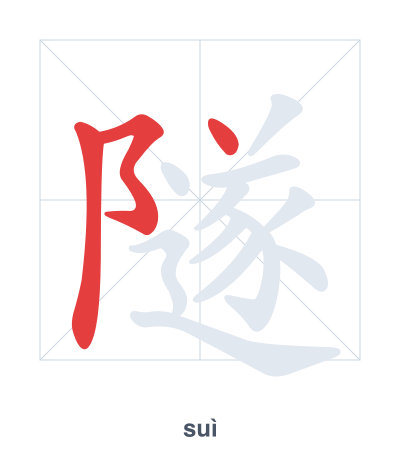
Open Hanzi Writer to see the animated stroke order and practice writing 隧 with real-time feedback.
The character 隧 (suì) is written with 14 strokes. Follow the standard Chinese stroke order: top to bottom, left to right, outside before inside. The radical 阝 is one of its key components.
Practice the correct stroke order with the Hanzi Writer app to see animated stroke-by-stroke guidance with real-time feedback.
隧 means tunnel.
As an HSK Level 7 character, 隧 is an intermediate-level character.
This character combines the radical 阝 (meaning 'mound' or 'hill') with 遂 (suì, meaning 'to advance'), creating a compound that depicts a passageway dug through a hill—a tunnel. The right side also provides phonetic pronunciation.
💡 Memory Tip: Picture a mole following (遂) its nose to dig a tunnel straight through a hill (阝).
隧道里非常黑。
suì dào lǐ fēi cháng hēi
It is very dark inside the tunnel.
火车正在过隧道。
huǒ chē zhèng zài guò suì dào
The train is passing through a tunnel.
我们在隧道口等。
wǒ men zài suì dào kǒu děng
We are waiting at the tunnel entrance.
Open Hanzi Writer to see the animated stroke order and practice writing 隧 with real-time feedback.
✨ Animated stroke order · Handwriting recognition · HSK-graded practice · Free to use
The character 隧 combines the radical 阝 (a variant of 阜, meaning 'mound' or 'hill') on the left with 遂 (suì) on the right for sound. The left radical suggests an underground passage or cave in a hill, while the right part gives the pronunciation. Together, they create the idea of a path dug through a mound, which is a tunnel.