鄙 (bǐ) means "lowly or despicable" in Chinese. It has 13 strokes with the radical 阝, and is HSK Level 7.
Rated 3.9/5 in difficulty (challenging).
Harder than 37% of HSK Level 7 characters.
Appears in 3+ common words including 鄙视 (bǐ shì), 卑鄙 (bēi bǐ), 鄙人 (bǐ rén).
Due to its 13 strokes, Hanzi Writer's error detection shows 鄙 requires focused practice — most learners need 10+ attempts for consistent accuracy.
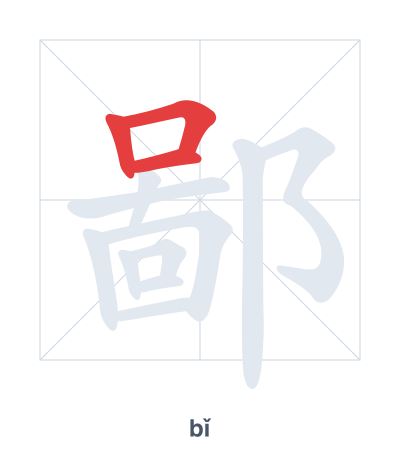
Open Hanzi Writer to see the animated stroke order and practice writing 鄙 with real-time feedback.
The character 鄙 (bǐ) is written with 13 strokes. Follow the standard Chinese stroke order: top to bottom, left to right, outside before inside. The radical 阝 is one of its key components.
Practice the correct stroke order with the Hanzi Writer app to see animated stroke-by-stroke guidance with real-time feedback.
鄙 means lowly or despicable.
As an HSK Level 7 character, 鄙 is an intermediate-level character.
The character 鄙 combines 阝 (a mound or hill, indicating a place) with 啚 (bǐ), which originally meant a grain storehouse in a rural area. In ancient China, remote villages were considered uncivilized and lowly compared to the capital, so 鄙 evolved to mean 'lowly' or 'despicable.'
💡 Memory Tip: Imagine a lowly person (啚 looks like a mouth under a lid and a box) cowering behind a mound (阝) because everyone thinks they're despicable.
不要鄙视别人。
bú yào bǐ shì bié rén
Don't look down on others.
他这样做很卑鄙。
tā zhè yàng zuò hěn bēi bǐ
What he did was very despicable.
鄙人姓王。
bǐ rén xìng wáng
My humble surname is Wang.
Open Hanzi Writer to see the animated stroke order and practice writing 鄙 with real-time feedback.
✨ Animated stroke order · Handwriting recognition · HSK-graded practice · Free to use
The left component 阝 (yì) means "city" or "place." The right component 啚 (bǐ) originally suggested a remote or lowly area. Together, 鄙 once referred to a humble village, which evolved into the meanings of "lowly" or "despicable."