鄢 (yān) means "Yan (a surname or ancient place)" in Chinese. It has 13 strokes with the radical 阝.
Rated 3.9/5 in difficulty (challenging).
Appears in 3+ common words including 鄢陵 (yān líng), 鄢郢 (yān yǐng), 姓鄢 (xìng yān).
Due to its 13 strokes, Hanzi Writer's error detection shows 鄢 requires focused practice — most learners need 10+ attempts for consistent accuracy.
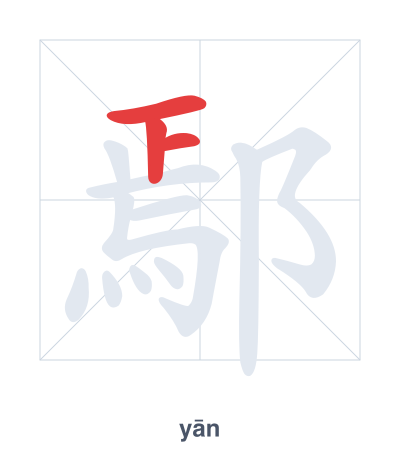
Open Hanzi Writer to see the animated stroke order and practice writing 鄢 with real-time feedback.
The character 鄢 (yān) is written with 13 strokes. Follow the standard Chinese stroke order: top to bottom, left to right, outside before inside. The radical 阝 is one of its key components.
Practice the correct stroke order with the Hanzi Writer app to see animated stroke-by-stroke guidance with real-time feedback.
鄢 means Yan (a surname or ancient place).
鄢 combines the radical 阝 (a variant of 阜, meaning 'mound' or 'place') with 焉 (yān), which serves as a phonetic component and originally depicted a bird or a locative particle. Together, they signify a specific ancient place near a mound, later used as a surname.
💡 Memory Tip: Picture a hill (阝) where a strange bird (焉) perches, marking the ancient territory of Yan.
鄢陵的花很有名。
yān líng de huā hěn yǒu míng
The flowers in Yanling are very famous.
鄢郢是古地名。
yān yǐng shì gǔ dì míng
Yanying is an ancient place name.
他姓鄢。
tā xìng yān
His surname is Yan.
Open Hanzi Writer to see the animated stroke order and practice writing 鄢 with real-time feedback.
✨ Animated stroke order · Handwriting recognition · HSK-graded practice · Free to use
鄢 is made of the left radical 阝 (city/hill) and the right part 焉 (which gives the sound yān). The 阝 shows that it was originally a place name, and 焉 acts as a phonetic hint. So together, it means a place called Yan or a surname from that area.