搜 (sōu) means "to search" in Chinese. It has 12 strokes with the radical 扌, and is HSK Level 5.
Rated 4.2/5 in difficulty (advanced).
Harder than 71% of HSK Level 5 characters.
Appears in 3+ common words including 搜索 (sōu suǒ), 搜查 (sōu chá), 搜集 (sōu jí).
Due to its 12 strokes, Hanzi Writer's error detection shows 搜 requires focused practice — most learners need 10+ attempts for consistent accuracy.
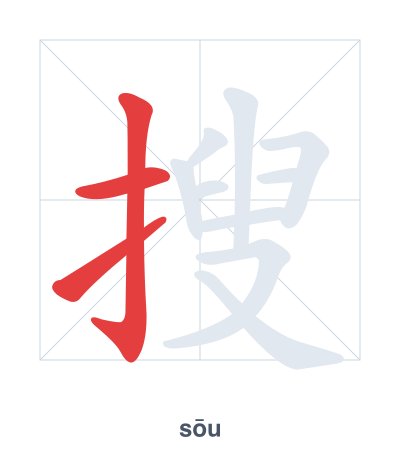
Open Hanzi Writer to see the animated stroke order and practice writing 搜 with real-time feedback.
The character 搜 (sōu) is written with 12 strokes. Follow the standard Chinese stroke order: top to bottom, left to right, outside before inside. The radical 扌 is one of its key components.
Practice the correct stroke order with the Hanzi Writer app to see animated stroke-by-stroke guidance with real-time feedback.
搜 means to search.
As an HSK Level 5 character, 搜 is an intermediate-level character.
搜 combines the hand radical 扌 (indicating an action) with 叟, an old man that serves as a phonetic component. Originally it depicted the act of searching by hand, perhaps through the belongings of an elderly person, linking the shape to the meaning of 'to search.'
💡 Memory Tip: Imagine a hand (扌) rummaging through an old man's (叟) wrinkled pockets to find a lost treasure.
在网上搜索一下答案。
zài wǎng shàng sōu suǒ yī xià dá àn
Search for the answer online.
警察正在搜查那个房间。
jǐng chá zhèng zài sōu chá nà ge fáng jiān
The police are searching that room.
他喜欢搜集旧邮票。
tā xǐ huān sōu jí jiù yóu piào
He likes collecting old stamps.
Open Hanzi Writer to see the animated stroke order and practice writing 搜 with real-time feedback.
✨ Animated stroke order · Handwriting recognition · HSK-graded practice · Free to use
搜 is made of two parts: the left radical 扌 (hand) and the right component 叟 (sǒu, meaning old man but here provides pronunciation). Since 扌 suggests a hand action, the overall meaning "to search" comes from the idea of using your hands to look through things, like an old man searching his belongings.