振 (zhèn) means "to shake; to flap; to brace up" in Chinese. It has 10 strokes with the radical 扌, and is HSK Level 5.
Rated 4.2/5 in difficulty (advanced).
Harder than 69% of HSK Level 5 characters.
Appears in 3+ common words including 振动 (zhèn dòng), 振作 (zhèn zuò), 振兴 (zhèn xīng).
Due to its 10 strokes, Hanzi Writer's error detection shows 振 requires focused practice — most learners need 10+ attempts for consistent accuracy.
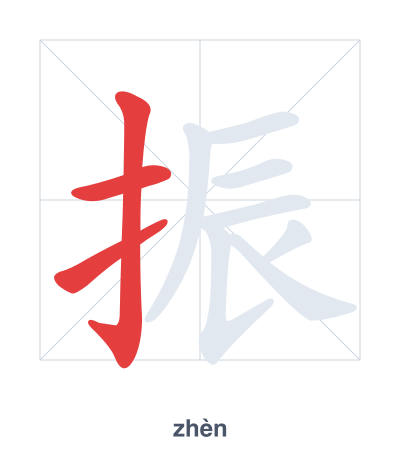
Open Hanzi Writer to see the animated stroke order and practice writing 振 with real-time feedback.
The character 振 (zhèn) is written with 10 strokes. Follow the standard Chinese stroke order: top to bottom, left to right, outside before inside. The radical 扌 is one of its key components.
Practice the correct stroke order with the Hanzi Writer app to see animated stroke-by-stroke guidance with real-time feedback.
振 means to shake; to flap; to brace up.
As an HSK Level 5 character, 振 is an intermediate-level character.
振 combines the hand radical 扌 (hand) with 辰, which originally depicted a clam shell but here serves as a phonetic component, also suggesting vibration (like in 震). The hand making a shaking or flapping motion conveys the meanings to shake, flap, or brace up.
💡 Memory Tip: Picture a hand (扌) vigorously shaking a morning (辰) alarm clock to flap it awake and brace up for the day.
手机在桌上振动。
shǒu jī zài zhuō shàng zhèn dòng
The phone is vibrating on the table.
你要振作起来。
nǐ yào zhèn zuò qǐ lái
You need to pull yourself together.
振兴家乡的经济。
zhèn xīng jiā xiāng de jīng jì
Revitalize the economy of one's hometown.
Open Hanzi Writer to see the animated stroke order and practice writing 振 with real-time feedback.
✨ Animated stroke order · Handwriting recognition · HSK-graded practice · Free to use
振 is composed of the radical 扌 (hand) on the left and the phonetic component 辰 (chén) on the right. The hand radical suggests actions done with the hand, such as shaking or flapping. The right part gives the sound zhèn and also carries a sense of movement, reinforcing the idea of bracing up or vibrating.