蔬 (shū) means "vegetable" in Chinese. It has 15 strokes with the radical 艹, and is HSK Level 5.
Rated 4.2/5 in difficulty (advanced).
Harder than 91% of HSK Level 5 characters.
Appears in 3+ common words including 蔬菜 (shū cài), 生蔬 (shēng shū), 蔬果 (shū guǒ).
Due to its 15 strokes, Hanzi Writer's error detection shows 蔬 requires focused practice — most learners need 10+ attempts for consistent accuracy.
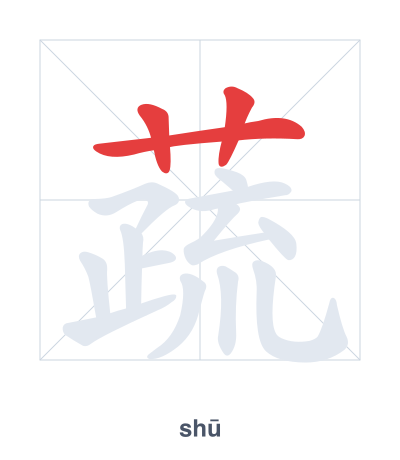
Open Hanzi Writer to see the animated stroke order and practice writing 蔬 with real-time feedback.
The character 蔬 (shū) is written with 15 strokes. Follow the standard Chinese stroke order: top to bottom, left to right, outside before inside. The radical 艹 is one of its key components.
Practice the correct stroke order with the Hanzi Writer app to see animated stroke-by-stroke guidance with real-time feedback.
蔬 means vegetable.
As an HSK Level 5 character, 蔬 is an intermediate-level character.
This character is a phono-semantic compound: the 'grass' radical (艹) indicates it is a plant, while the component 疏 (shū) provides the pronunciation and hints at the sparse, leafy nature of many vegetables.
💡 Memory Tip: Picture a vegetable garden where the plants (艹) are spaced far apart (疏) so each leafy green gets plenty of sunlight.
多吃蔬菜对身体好。
duō chī shū cài duì shēn tǐ hǎo
Eating more vegetables is good for your health.
超市里的生蔬很新鲜。
chāo shì lǐ de shēng shū hěn xīn xiān
The fresh vegetables in the supermarket are very fresh.
每天都要吃点蔬果。
měi tiān dōu yào chī diǎn shū guǒ
Eat some fruits and vegetables every day.
Open Hanzi Writer to see the animated stroke order and practice writing 蔬 with real-time feedback.
✨ Animated stroke order · Handwriting recognition · HSK-graded practice · Free to use
蔬 is composed of the radical 艹 (grass radical) on top, which indicates that the character relates to plants or herbs, and the phonetic component 疏 (shū) underneath, which provides a hint to the pronunciation. The plant radical combined with the sound component gives the meaning of 'vegetable'—a type of edible plant.