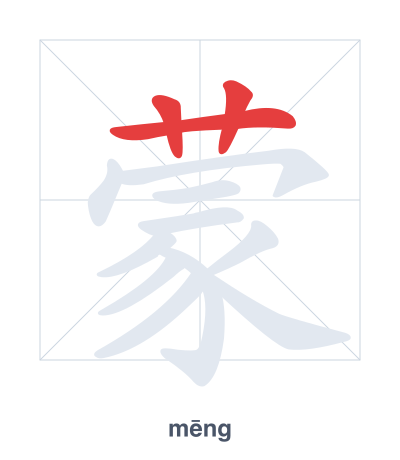
蒙 (mēng) means "Mongol; to cover; to deceive" in Chinese. It has 13 strokes with the radical 艹, and is HSK Level 6. Difficulty: 4.2/5.
Mongol; to cover; to deceive
The character 蒙 (mēng) is written with 13 strokes. Follow the standard Chinese stroke order: top to bottom, left to right, outside before inside. The radical 艹 is one of its key components.
Practice the correct stroke order with the Hanzi Writer app to see animated stroke-by-stroke guidance with real-time feedback.
蒙 is pronounced mēng in Mandarin Chinese. It means Mongol; to cover; to deceive.
This is a polyphonic character with readings: mēng, méng, měng.
As an HSK Level 6 character, 蒙 is an intermediate-level character.
父母是孩子的第一任启蒙老师。
fù mǔ shì hái zi de dì yī rèn qǐ méng lǎo shī
Parents are a child's first enlightenment teachers.
我们要保持清醒的头脑,不被假象所蒙蔽。
wǒ men yào bǎo chí qīng xǐng de tóu nǎo bù bèi jiǎ xiàng suǒ méng bì
We must keep a clear head and not be deceived by false appearances.
辽阔的蒙古草原上奔跑着成群的骏马。
liáo kuò de měng gǔ cǎo yuán shàng bēn pǎo zhe chéng qún de jùn mǎ
Herds of fine horses run across the vast Mongolian grasslands.
这道题他不会做,只是随便瞎蒙了一个答案。
zhè dào tí tā bú huì zuò zhǐ shì suí biàn xiā mēng le yí gè dá àn
He didn't know how to solve this problem, so he just took a wild guess at the answer.
Open Hanzi Writer to see the animated stroke order and practice writing 蒙 with real-time feedback.