蒗 (làng) means "Lang (used in place names like Ninglang)" in Chinese. It has 13 strokes with the radical 艹.
Rated 4.2/5 in difficulty (advanced).
Appears in 3+ common words including 宁蒗 (níng làng), 蒗渠 (làng qú), 蒗荡 (làng dàng).
Due to its 13 strokes, Hanzi Writer's error detection shows 蒗 requires focused practice — most learners need 10+ attempts for consistent accuracy.
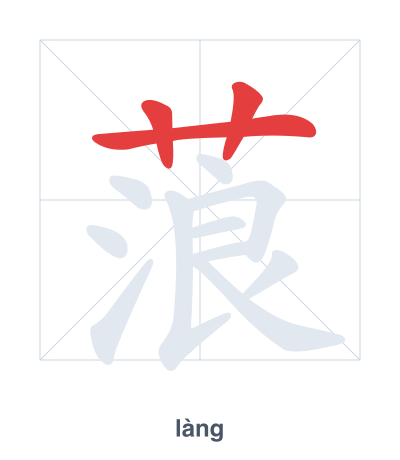
Open Hanzi Writer to see the animated stroke order and practice writing 蒗 with real-time feedback.
The character 蒗 (làng) is written with 13 strokes. Follow the standard Chinese stroke order: top to bottom, left to right, outside before inside. The radical 艹 is one of its key components.
Practice the correct stroke order with the Hanzi Writer app to see animated stroke-by-stroke guidance with real-time feedback.
蒗 means Lang (used in place names like Ninglang).
蒗 is a compound character with the grass radical 艹 indicating a plant, and 浪 (làng, meaning 'wave') providing the phonetic component. It is primarily used in place names like Ninglang in Yunnan, originally referring to a type of grass or vegetation associated with that region.
💡 Memory Tip: Picture a green wave (浪) of grass (艹) rolling through the landscape of Ninglang.
宁蒗在云南省。
níng làng zài yún nán shěng
Ninglang is in Yunnan Province.
这里有一条蒗渠。
zhè lǐ yǒu yī tiáo làng qú
There is a Lang canal here.
水面看起来很蒗荡。
shuǐ miàn kàn qǐ lái hěn làng dàng
The water surface looks vast and expansive.
Open Hanzi Writer to see the animated stroke order and practice writing 蒗 with real-time feedback.
✨ Animated stroke order · Handwriting recognition · HSK-graded practice · Free to use
蒗 is made of the radical 艹 (grass) on top and the phonetic component 浪 (làng, meaning wave) below. The grass radical hints that 蒗 relates to plants, as seen in the word 蒗荡 (scopolia, a plant). The phonetic part 浪 suggests the pronunciation làng but does not directly connect to the meaning.