生 (shēng) means "to give birth; raw; life" in Chinese. It has 5 strokes with the radical 生, and is HSK Level 1.
Rated 1.8/5 in difficulty (beginner-friendly).
Harder than 11% of HSK Level 1 characters.
Appears in 3+ common words including 生日 (shēng rì), 学生 (xué shēng), 生活 (shēng huó).
In the Hanzi Writer app, most learners master 生 within 3 practice attempts using stroke-by-stroke animation.
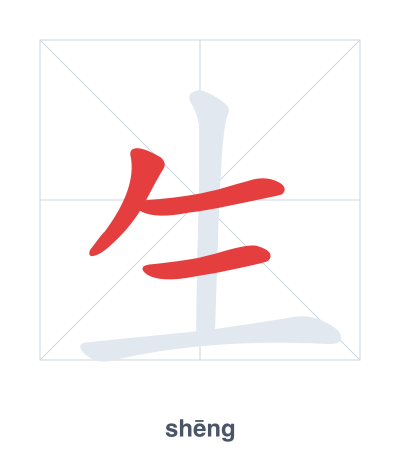
Open Hanzi Writer to see the animated stroke order and practice writing 生 with real-time feedback.
The character 生 (shēng) is written with 5 strokes. Follow the standard Chinese stroke order: top to bottom, left to right, outside before inside. The radical 生 is one of its key components.
Practice the correct stroke order with the Hanzi Writer app to see animated stroke-by-stroke guidance with real-time feedback.
生 means to give birth; raw; life.
As an HSK Level 1 character, 生 is among the first characters beginners learn.
The character 生 originally depicted a plant sprouting from the ground, with the top part representing the seedling and the bottom stroke symbolizing the earth. This pictograph visually conveys the idea of life emerging, which evolved into meanings like 'to give birth,' 'raw,' and 'life.'
💡 Memory Tip: Imagine a tiny green sprout (生) pushing up through the soil, bursting with new life and raw energy.
祝你生日快乐。
zhù nǐ shēng rì kuài lè
Happy birthday.
我是一名学生。
wǒ shì yī míng xué shēng
I am a student.
这里的生活很方便。
zhè lǐ de shēng huó hěn fāng biàn
Life here is very convenient.
Open Hanzi Writer to see the animated stroke order and practice writing 生 with real-time feedback.
✨ Animated stroke order · Handwriting recognition · HSK-graded practice · Free to use
生 is a pictograph that shows a sprout growing from the ground. The top strokes represent the sprout and leaves, while the bottom horizontal line represents the earth. This image of new growth connects directly to the character's meanings of 'to give birth' and 'life'.