Hanzi Writer

How to Write 殖 (shi/zhí) — Meaning “to breed; to multiply; to colonize”

shi/zhí HSK Level 6 12 strokes Radical: 歹

殖 (shi/zhí) means "to breed; to multiply; to colonize" in Chinese. It has 12 strokes with the radical 歹, and is HSK Level 6.

Rated 4.2/5 in difficulty (advanced).

Harder than 72% of HSK Level 6 characters.

Appears in 3+ common words including 繁殖 (fán zhí), 养殖 (yǎng zhí), 骨殖 (gǔ shi).

Due to its 12 strokes, Hanzi Writer's error detection shows 殖 requires focused practice — most learners need 10+ attempts for consistent accuracy.
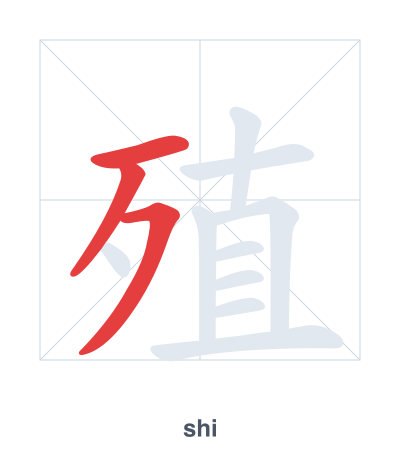
Stroke order practice for 殖 - shi/zhí

Practice Writing 殖 (shi/zhí)

Open Hanzi Writer to see the animated stroke order and practice writing 殖 with real-time feedback.

The character (shi/zhí) is written with 12 strokes. Follow the standard Chinese stroke order: top to bottom, left to right, outside before inside. The radical is one of its key components.

Practice the correct stroke order with the Hanzi Writer app to see animated stroke-by-stroke guidance with real-time feedback.

means to breed; to multiply; to colonize.

This is a polyphonic character with readings: shi, zhí.

As an HSK Level 6 character, is an intermediate-level character.

Character
Pinyinshi / zhí
Meaningto breed; to multiply; to colonize
Strokes12
Radical
HSK Level6
Difficulty4.2/5

殖 combines 歹 (death/decayed bone) and 直 (straight). Originally it meant 'to pile up'—like heaping corpses—then extended to accumulating wealth and finally to breeding or multiplying. The 歹 radical hints at the cycle of life and death, while 直 provides the sound and a sense of orderly increase.

💡 Memory Tip: Picture a dead skeleton (歹) lying straight (直) on the ground, then hundreds of tiny bones sprout from it, breeding and multiplying like crazy.

fán zhí
to breed or reproduce
yǎng zhí
To breed; to cultivate; aquaculture
gǔ shi
Remains; bones of the dead.

春天是万物生长的季节,也是动物繁殖的季节。

chūn tiān shì wàn wù shēng zhǎng de jì jié yě shì dòng wù fán zhí de jì jié

Spring is the season when everything grows and also the season for animals to breed.

他承包了一个池塘,专门从事淡水鱼类养殖。

tā chéng bāo le yí gè chí táng zhuān mén cóng shì dàn shuǐ yú lèi yǎng zhí

He contracted a pond specifically for freshwater fish farming.

考古学家在遗址中发现了一些古代动物的骨殖。

kǎo gǔ xué jiā zài yí zhǐ zhōng fā xiàn le yī xiē gǔ dài dòng wù de gǔ shi

Archaeologists discovered some ancient animal remains at the site.

Character Pinyin Strokes Radical
(current) shi / zhí 12
xùn 10
shū 10
piǎo 11
Stroke order practice for 殖 - shi/zhí

Practice Writing 殖 (shi/zhí)

Open Hanzi Writer to see the animated stroke order and practice writing 殖 with real-time feedback.

✨ Animated stroke order · Handwriting recognition · HSK-graded practice · Free to use

Frequently Asked Questions about 殖

殖 is composed of the radical 歹 (meaning "bad" or "death") on the left and the phonetic component 直 (zhí, meaning "straight") on the right. The 歹 radical connects to the idea of death or remains (as in 骨殖), while 直 provides pronunciation and ties to the meaning of "to multiply" through the concept of continuous, straight growth. Combined, they reflect reproduction that continues despite or involving death, such as in breeding or colonization.

More HSK Level 6 Characters

Characters with Radical 歹

Other 12-Stroke Characters