养 (yǎng) means "To raise; to support; to cultivate" in Chinese. It has 9 strokes with the radical 丷, and is HSK Level 2.
Rated 3.2/5 in difficulty (challenging).
Harder than 44% of HSK Level 2 characters.
Appears in 3+ common words including 养猫 (yǎng māo), 养成 (yǎng chéng), 营养 (yíng yǎng).
Due to its 9 strokes, Hanzi Writer's error detection shows 养 requires focused practice — most learners need 10+ attempts for consistent accuracy.
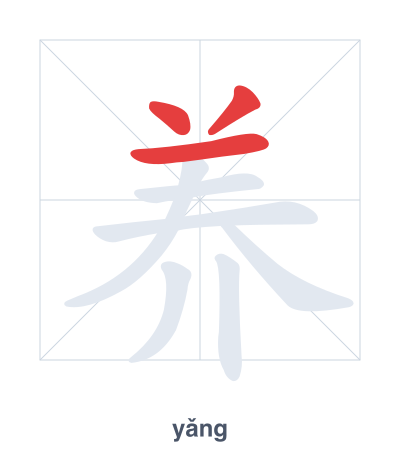
Open Hanzi Writer to see the animated stroke order and practice writing 养 with real-time feedback.
The character 养 (yǎng) is written with 9 strokes. Follow the standard Chinese stroke order: top to bottom, left to right, outside before inside. The radical 丷 is one of its key components.
Practice the correct stroke order with the Hanzi Writer app to see animated stroke-by-stroke guidance with real-time feedback.
养 means To raise; to support; to cultivate.
As an HSK Level 2 character, 养 is among the first characters beginners learn.
The character 养 is the simplified form of 養, which originally combined 羊 (sheep) and 食 (food), depicting the act of feeding a sheep to raise it. Over time, the form simplified: the top part 丷 represents the sheep's horns, while the lower part retains a simplified hint of the food container or nourishment. Thus, the visual structure conveys the idea of providing sustenance to cultivate or support.
💡 Memory Tip: Picture a shepherd with a horn-like hat (丷) standing beside a sheep (羊's horns), scooping food from a bowl (the remaining strokes) to raise it.
她每天下班后最开心的事就是回家养猫。
tā měi tiān xià bān hòu zuì kāi xīn de shì jiù shì huí jiā yǎng māo 。
The happiest thing for her after work every day is going home to take care of her cat.
我们要养成好习惯。
wǒ men yào yǎng chéng hǎo xí guàn
We should develop good habits.
牛奶很有营养。
niú nǎi hěn yǒu yíng yǎng
Milk is very nutritious.
Open Hanzi Writer to see the animated stroke order and practice writing 养 with real-time feedback.
✨ Animated stroke order · Handwriting recognition · HSK-graded practice · Free to use
The character 养 consists of a top part 丷 (like a pair of sheep horns) and a bottom part 良 (meaning 'good'). Together, they suggest providing good care, which connects to the meanings of raising or nourishing.