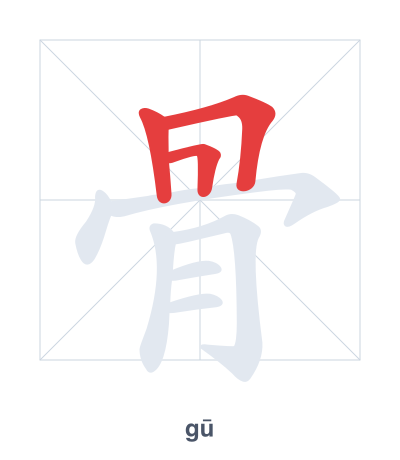
骨 (gū) means "bone" in Chinese. It has 9 strokes with the radical 骨, and is HSK Level 4. Difficulty: 3.3/5.
bone
The character 骨 (gū) is written with 9 strokes. Follow the standard Chinese stroke order: top to bottom, left to right, outside before inside. The radical 骨 is one of its key components.
Practice the correct stroke order with the Hanzi Writer app to see animated stroke-by-stroke guidance with real-time feedback.
骨 is pronounced gū in Mandarin Chinese. It means bone.
This is a polyphonic character with readings: gū, gǔ.
As an HSK Level 4 character, 骨 is an intermediate-level character.
小狗正蹲在门口,开心地啃着一块骨头。
xiǎo gǒu zhèng dūn zài mén kǒu kāi xīn dì kěn zhe yī kuài gǔ tou
The puppy is crouching at the door, happily gnawing on a bone.
他是我们公司的业务骨干,能力非常强。
tā shì wǒ men gōng sī de yè wù gǔ gàn néng lì fēi cháng qiáng
He is a key member of our company's business team and is very capable.
春风吹过,桃树上长满了红通通的花骨朵儿。
chūn fēng chuī guò táo shù shàng zhǎng mǎn le hóng tōng tōng de huā gū duǒ ér
As the spring breeze blows, the peach trees are covered with bright red flower buds.
小花猫从楼梯上骨碌一下滚了下来。
xiǎo huā māo cóng lóu tī shàng gū lù yī xià gǔn le xià lái
The little calico cat rolled down the stairs with a tumble.
Open Hanzi Writer to see the animated stroke order and practice writing 骨 with real-time feedback.