死 (sǐ) means "To die; dead" in Chinese. It has 6 strokes with the radical 歹, and is HSK Level 3.
Rated 3.2/5 in difficulty (challenging).
Harder than 31% of HSK Level 3 characters.
Appears in 3+ common words including 死了 (sǐ le), 累死 (lèi sǐ), 死亡 (sǐ wáng).
Due to its 6 strokes, Hanzi Writer's error detection shows 死 requires focused practice — most learners need 10+ attempts for consistent accuracy.
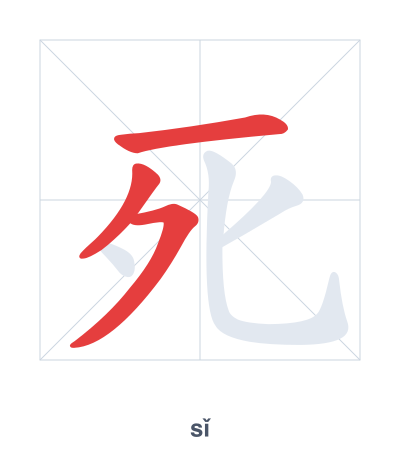
Open Hanzi Writer to see the animated stroke order and practice writing 死 with real-time feedback.
The character 死 (sǐ) is written with 6 strokes. Follow the standard Chinese stroke order: top to bottom, left to right, outside before inside. The radical 歹 is one of its key components.
Practice the correct stroke order with the Hanzi Writer app to see animated stroke-by-stroke guidance with real-time feedback.
死 means To die; dead.
As an HSK Level 3 character, 死 is an intermediate-level character.
The character 死 combines 歹, a pictograph of a decomposed corpse, with 匕, originally depicting a person bowing or turning away, together showing a person beside remains or turning from life — representing death.
💡 Memory Tip: Picture a skeleton (歹) raising a hand (the top stroke of 匕) as if to say 'I'm dead!'
那盆花已经死了。
nà pén huā yǐ jīng sǐ le
That potted flower is already dead.
今天我快累死了。
jīn tiān wǒ kuài lèi sǐ le
I'm exhausted today.
死亡是自然规律。
sǐ wáng shì zì rán guī lǜ
Death is a law of nature.
Open Hanzi Writer to see the animated stroke order and practice writing 死 with real-time feedback.
✨ Animated stroke order · Handwriting recognition · HSK-graded practice · Free to use
The left part 歹 is the radical meaning 'bad' or 'death.' The right part 匕 originally showed a person bending down or a dagger. Together, they visually suggest a dead person or the act of dying.