殁 (mò) means "to die; to pass away" in Chinese. It has 8 strokes with the radical 歹.
Rated 3.7/5 in difficulty (challenging).
Appears in 3+ common words including 殁世 (mò shì), 战殁 (zhàn mò), 病殁 (bìng mò).
Due to its 8 strokes, Hanzi Writer's error detection shows 殁 requires focused practice — most learners need 10+ attempts for consistent accuracy.
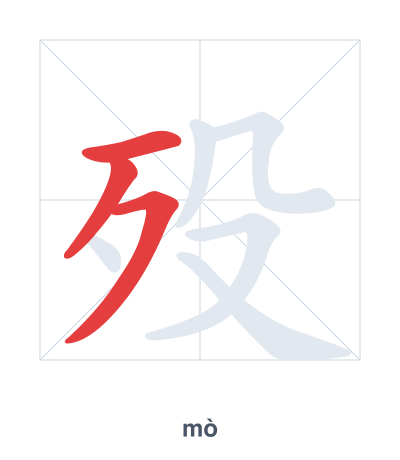
Open Hanzi Writer to see the animated stroke order and practice writing 殁 with real-time feedback.
The character 殁 (mò) is written with 8 strokes. Follow the standard Chinese stroke order: top to bottom, left to right, outside before inside. The radical 歹 is one of its key components.
Practice the correct stroke order with the Hanzi Writer app to see animated stroke-by-stroke guidance with real-time feedback.
殁 means to die; to pass away.
| Character | 殁 |
| Pinyin | mò (mo) |
| Meaning | to die; to pass away |
| Strokes | 8 |
| Radical | 歹 |
| Difficulty | 3.7/5 |
The left radical 歹 (dǎi) depicts a broken bone or remains, symbolizing death. The right component 殳 (shū) originally showed a hand holding a weapon, indicating a striking action. Together, 殁 means to die, often from a violent blow.
💡 Memory Tip: Picture a skeleton (歹) being clubbed by a weapon (殳) — that's how you die (殁).
他殁世多年了。
tā mò shì duō nián le
He has been dead for many years.
许多士兵战殁了。
xǔ duō shì bīng zhàn mò le
Many soldiers died in battle.
他因病殁于家中。
tā yīn bìng mò yú jiā zhōng
He passed away at home due to illness.
Open Hanzi Writer to see the animated stroke order and practice writing 殁 with real-time feedback.
✨ Animated stroke order · Handwriting recognition · HSK-graded practice · Free to use
The left component 歹 (slanted 'death' radical) hints at death or misfortune. The right part 殳 originally depicted a hand holding a weapon, so together the character suggests dying from a strike or violent end.