殂 (cú) means "to die (literary)" in Chinese. It has 9 strokes with the radical 歹.
Rated 4/5 in difficulty (challenging).
Appears in 3+ common words including 殂落 (cú luò), 殂谢 (cú xiè), 崩殂 (bēng cú).
Due to its 9 strokes, Hanzi Writer's error detection shows 殂 requires focused practice — most learners need 10+ attempts for consistent accuracy.
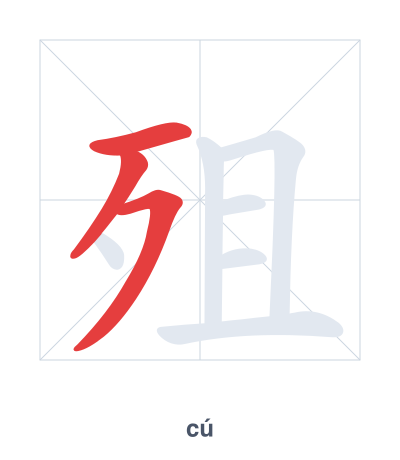
Open Hanzi Writer to see the animated stroke order and practice writing 殂 with real-time feedback.
The character 殂 (cú) is written with 9 strokes. Follow the standard Chinese stroke order: top to bottom, left to right, outside before inside. The radical 歹 is one of its key components.
Practice the correct stroke order with the Hanzi Writer app to see animated stroke-by-stroke guidance with real-time feedback.
殂 means to die (literary).
| Character | 殂 |
| Pinyin | cú (cu) |
| Meaning | to die (literary) |
| Strokes | 9 |
| Radical | 歹 |
| Difficulty | 4/5 |
殂 combines the radical 歹 (a remnant of a skeleton, representing death) with 且 (originally a picture of a tomb or ancestral altar). Together they depict a corpse placed at a tomb, visually conveying the literary meaning 'to die'.
💡 Memory Tip: Picture the left 歹 as a pile of bones and the right 且 as an altar; the bones are laid upon the altar as a final offering after death.
英雄不幸殂落。
yīng xióng bù xìng cú luò
The hero unfortunately passed away.
岁月流逝人已殂谢。
suì yuè liú shì rén yǐ cú xiè
Time has passed and the person has passed away.
古代皇帝崩殂了。
gǔ dài huáng dì bēng cú le
The ancient emperor passed away.
Open Hanzi Writer to see the animated stroke order and practice writing 殂 with real-time feedback.
✨ Animated stroke order · Handwriting recognition · HSK-graded practice · Free to use
The left component 歹 (death radical) indicates that the meaning is related to death. The right component 且 provides a phonetic clue for the pronunciation 'cú', though not exact. Together, they create the literary meaning 'to die.'