殊 (shū) means "special; different; very" in Chinese. It has 10 strokes with the radical 歹, and is HSK Level 4.
Rated 4.2/5 in difficulty (advanced).
Harder than 76% of HSK Level 4 characters.
Appears in 3+ common words including 特殊 (tè shū), 殊死 (shū sǐ), 殊荣 (shū róng).
Due to its 10 strokes, Hanzi Writer's error detection shows 殊 requires focused practice — most learners need 10+ attempts for consistent accuracy.
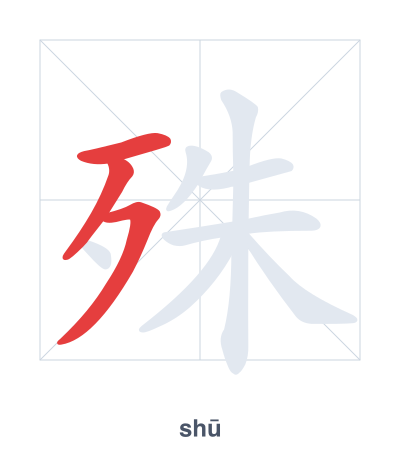
Open Hanzi Writer to see the animated stroke order and practice writing 殊 with real-time feedback.
The character 殊 (shū) is written with 10 strokes. Follow the standard Chinese stroke order: top to bottom, left to right, outside before inside. The radical 歹 is one of its key components.
Practice the correct stroke order with the Hanzi Writer app to see animated stroke-by-stroke guidance with real-time feedback.
殊 means special; different; very.
As an HSK Level 4 character, 殊 is an intermediate-level character.
The character 殊 combines the radical 歹 (death) with the phonetic component 朱 (red). Originally meaning 'to die' or 'to execute,' it later extended to mean 'different' or 'special'—something that stands apart, like a unique fate.
💡 Memory Tip: Picture a very special red (朱) skull (歹) that marks something as completely different from the rest.
这是一个特殊的情况。
zhè shì yí gè tè shū de qíng kuàng
This is a special situation.
他们进行了殊死搏斗。
tā men jìn xíng le shū sǐ bó dòu
They engaged in a life-and-death struggle.
他获得了这项殊荣。
tā huò dé le zhè xiàng shū róng
He received this special honor.
Open Hanzi Writer to see the animated stroke order and practice writing 殊 with real-time feedback.
✨ Animated stroke order · Handwriting recognition · HSK-graded practice · Free to use
The left side is the radical 歹, which often relates to death or danger. The right side is 朱, which gives the pronunciation 'shū'. Together, they create a character meaning 'special' or 'different', though the exact connection to the radical is not direct.