殇 (shāng) means "to die young" in Chinese. It has 9 strokes with the radical 歹.
Rated 4/5 in difficulty (challenging).
Appears in 3+ common words including 国殇 (guó shāng), 夭殇 (yāo shāng), 殇折 (shāng zhé).
Due to its 9 strokes, Hanzi Writer's error detection shows 殇 requires focused practice — most learners need 10+ attempts for consistent accuracy.
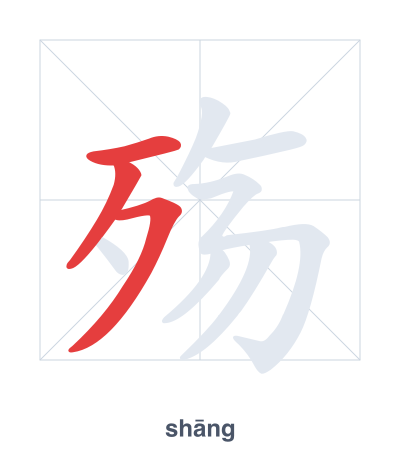
Open Hanzi Writer to see the animated stroke order and practice writing 殇 with real-time feedback.
The character 殇 (shāng) is written with 9 strokes. Follow the standard Chinese stroke order: top to bottom, left to right, outside before inside. The radical 歹 is one of its key components.
Practice the correct stroke order with the Hanzi Writer app to see animated stroke-by-stroke guidance with real-time feedback.
殇 means to die young.
| Character | 殇 |
| Pinyin | shāng (shang) |
| Meaning | to die young |
| Strokes | 9 |
| Radical | 歹 |
| Difficulty | 4/5 |
The character 殇 combines the radical 歹 (meaning 'death' or 'decay') with the phonetic component 昜 (depicting sunlight). This pairing suggests a life cut short before it reaches its full brightness, symbolizing dying young.
💡 Memory Tip: Picture a young sun (昜) sinking into a graveyard (歹) far too early—its light extinguished before noon.
我们纪念国殇。
wǒ men jì niàn guó shāng
We commemorate those who died for the country.
那个孩子不幸夭殇。
nà ge hái zi bù xìng yāo shāng
That child unfortunately died young.
很多花朵在风中殇折。
hěn duō huā duǒ zài fēng zhōng shāng zhé
Many flowers were broken in the wind.
Open Hanzi Writer to see the animated stroke order and practice writing 殇 with real-time feedback.
✨ Animated stroke order · Handwriting recognition · HSK-graded practice · Free to use
殇 is composed of the radical 歹 (meaning death or bad) on the left, and the phonetic component 昜 on the right. The 歹 radical directly indicates that the character relates to death, while 昜 provides the pronunciation shāng. Together, they create the meaning of dying young.