勦 (chāo) means "to suppress or destroy" in Chinese. It has 13 strokes with the radical 力.
Rated 3.9/5 in difficulty (challenging).
Appears in 3+ common words including 勦灭 (chāo miè), 围勦 (wéi chāo), 勦除 (chāo chú).
Due to its 13 strokes, Hanzi Writer's error detection shows 勦 requires focused practice — most learners need 10+ attempts for consistent accuracy.
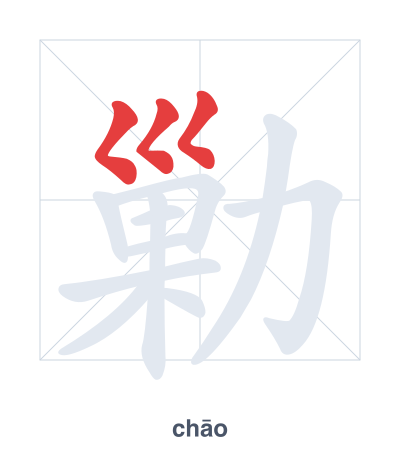
Open Hanzi Writer to see the animated stroke order and practice writing 勦 with real-time feedback.
The character 勦 (chāo) is written with 13 strokes. Follow the standard Chinese stroke order: top to bottom, left to right, outside before inside. The radical 力 is one of its key components.
Practice the correct stroke order with the Hanzi Writer app to see animated stroke-by-stroke guidance with real-time feedback.
勦 means to suppress or destroy.
勦 combines 巢 (cháo, 'nest') and 力 (strength/power), suggesting the use of forceful strength to destroy a nest, hence 'to suppress or eradicate' an enemy or threat. The left component 巢 originally depicted a tree with birds in a nest, and 力 adds the sense of exertion.
💡 Memory Tip: Picture a muscular arm (力) smashing a bird's nest (巢) on a tree branch, utterly destroying it.
军队勦灭了叛军。
jūn duì chāo miè le pàn jūn
The army suppressed the rebels.
警察展开了围勦。
jǐng chá zhǎn kāi le wéi chāo
The police launched a suppression operation.
必须勦除这些害虫。
bì xū chāo chú zhè xiē hài chóng
These pests must be eradicated.
Open Hanzi Writer to see the animated stroke order and practice writing 勦 with real-time feedback.
✨ Animated stroke order · Handwriting recognition · HSK-graded practice · Free to use
勦 is composed of the radical 力 (strength) on the right and the phonetic component 巢 (cháo, meaning 'nest') on the left. The 力 radical indicates that the character involves using force, while 巢 provides a hint to the pronunciation. Together, they suggest using strength to destroy something, like smashing a nest.