瓜 (guā) means "melon" in Chinese. It has 5 strokes with the radical 瓜, and is HSK Level 4.
Rated 2.3/5 in difficulty (moderate).
Harder than 4% of HSK Level 4 characters.
Appears in 3+ common words including 西瓜 (xī guā), 瓜子 (guā zi), 甜瓜 (tián guā).
Hanzi Writer's stroke validation shows learners typically need 5-8 attempts to write 瓜 with correct proportion and order.
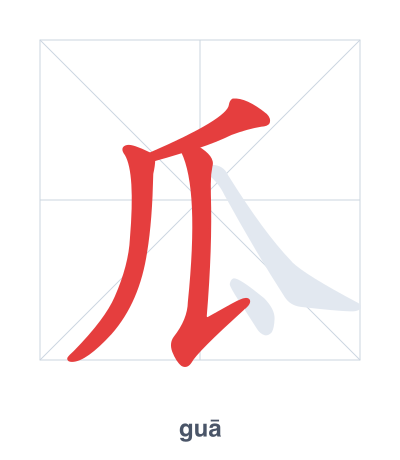
Open Hanzi Writer to see the animated stroke order and practice writing 瓜 with real-time feedback.
The character 瓜 (guā) is written with 5 strokes. Follow the standard Chinese stroke order: top to bottom, left to right, outside before inside. The radical 瓜 is one of its key components.
Practice the correct stroke order with the Hanzi Writer app to see animated stroke-by-stroke guidance with real-time feedback.
瓜 means melon.
As an HSK Level 4 character, 瓜 is an intermediate-level character.
瓜 is a pictograph of a melon hanging from a vine. In ancient oracle bone script, it showed a gourd-shaped fruit suspended from a tendril. The modern form still suggests the curved fruit and the stem above it.
💡 Memory Tip: Picture the character as a melon on a shelf: the top stroke is the stem, the left and right strokes are the round sides of the fruit, and the bottom strokes are the striped pattern.
我喜欢吃西瓜。
wǒ xǐ huān chī xī guā
I like eating watermelon.
我们一起吃瓜子吧。
wǒ men yì qǐ chī guā zi ba
Let's eat melon seeds together.
这个甜瓜很甜。
zhè ge tián guā hěn tián
This muskmelon is very sweet.
Open Hanzi Writer to see the animated stroke order and practice writing 瓜 with real-time feedback.
✨ Animated stroke order · Handwriting recognition · HSK-graded practice · Free to use
瓜 is a pictograph that looks like a melon hanging from a vine. The top part represents the stem and leaves, while the bottom part shows the round fruit. This direct visual connection makes it easy to remember that 瓜 means melon.