葡 (pú) means "grape" in Chinese. It has 12 strokes with the radical 艹, and is HSK Level 5.
Rated 4.2/5 in difficulty (advanced).
Harder than 91% of HSK Level 5 characters.
Appears in 3+ common words including 葡萄 (pú táo), 葡萄酒 (pú táo jiǔ), 葡萄干 (pú táo gān).
Due to its 12 strokes, Hanzi Writer's error detection shows 葡 requires focused practice — most learners need 10+ attempts for consistent accuracy.
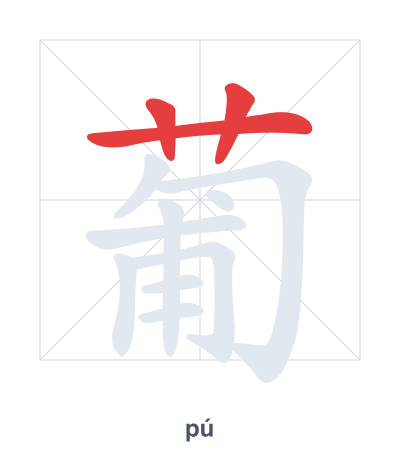
Open Hanzi Writer to see the animated stroke order and practice writing 葡 with real-time feedback.
The character 葡 (pú) is written with 12 strokes. Follow the standard Chinese stroke order: top to bottom, left to right, outside before inside. The radical 艹 is one of its key components.
Practice the correct stroke order with the Hanzi Writer app to see animated stroke-by-stroke guidance with real-time feedback.
葡 means grape.
As an HSK Level 5 character, 葡 is an intermediate-level character.
葡 is a compound character with the radical 艹 (grass/plant) indicating it's a type of plant, and the phonetic component 匍 (pú) which originally meant 'to crawl' or 'to lie prone.' This reflects how grapevines spread along the ground or climb by crawling.
💡 Memory Tip: Picture grass (艹) growing over a grapevine that crawls (匍) along a trellis, hanging with juicy grapes.
葡萄很甜。
pú táo hěn tián
The grapes are very sweet.
我喝葡萄酒。
wǒ hē pú táo jiǔ
I drink wine.
买点葡萄干。
mǎi diǎn pú táo gān
Buy some raisins.
Open Hanzi Writer to see the animated stroke order and practice writing 葡 with real-time feedback.
✨ Animated stroke order · Handwriting recognition · HSK-graded practice · Free to use
葡 contains the radical 艹 (grass) on top, which indicates it is a plant. The lower part 匍 provides the pronunciation pú and visually suggests a creeping vine, like a grape plant.