干 (gān/gàn) means "dry / to do / stem" in Chinese. It has 3 strokes with the radical 十, and is HSK Level 1.
Rated 1.7/5 in difficulty (beginner-friendly).
Harder than 10% of HSK Level 1 characters.
Appears in 4+ common words including 干净 (gān jìng), 干旱 (gān hàn), 干活 (gàn huó).
In the Hanzi Writer app, most learners master 干 within 3 practice attempts using stroke-by-stroke animation.
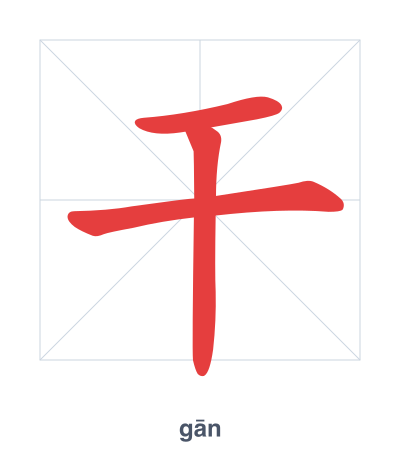
Open Hanzi Writer to see the animated stroke order and practice writing 干 with real-time feedback.
The character 干 (gān/gàn) is written with 3 strokes. Follow the standard Chinese stroke order: top to bottom, left to right, outside before inside. The radical 十 is one of its key components.
Practice the correct stroke order with the Hanzi Writer app to see animated stroke-by-stroke guidance with real-time feedback.
干 means dry / to do / stem.
This is a polyphonic character with readings: gān, gàn.
As an HSK Level 1 character, 干 is among the first characters beginners learn.
This character originally depicted a forked wooden pole or shield, a simple weapon that could also be used to prop up drying items, linking to the meanings 'stem' and 'dry.' Over time, it gained the extended meaning 'to do' from the idea of using such a tool for action.
💡 Memory Tip: Picture a straight, dry branch (stem) with a horizontal line through it, like a clothes hanger left out to dry in the sun.
我们要把教室打扫得干干净净。
wǒ men yào bǎ jiào shì dǎ sǎo dé gān gān jìng jìng
We need to clean the classroom thoroughly.
持续的干旱导致农作物大量枯死。
chí xù de gān hàn dǎo zhì nóng zuò wù dà liàng kū sǐ
Continuous drought has caused a large number of crops to wither and die.
他干活非常利索,从不拖泥带水。
tā gàn huó fēi cháng lì suǒ cóng bù tuō ní dài shuǐ
He works very efficiently and never leaves things half-done.
这里的村干部非常关心群众的生活。
zhè lǐ de cūn gàn bù fēi cháng guān xīn qún zhòng de shēng huó
The village officials here care very much about the lives of the people.
Open Hanzi Writer to see the animated stroke order and practice writing 干 with real-time feedback.
✨ Animated stroke order · Handwriting recognition · HSK-graded practice · Free to use
干 is made of three straight strokes: two horizontal lines crossed by one vertical line. This simple structure resembles a pole or a stem, which connects to the meaning 'stem', while the bare lines can suggest something 'dry' or stripped of water.