荸 (bí) means "Water chestnut (short for 荸荠)" in Chinese. It has 10 strokes with the radical 艹.
Rated 4.2/5 in difficulty (advanced).
Appears in 3+ common words including 荸荠 (bí qí), 荸荠水 (bí qí shuǐ), 荸荠糕 (bí qí gāo).
Due to its 10 strokes, Hanzi Writer's error detection shows 荸 requires focused practice — most learners need 10+ attempts for consistent accuracy.
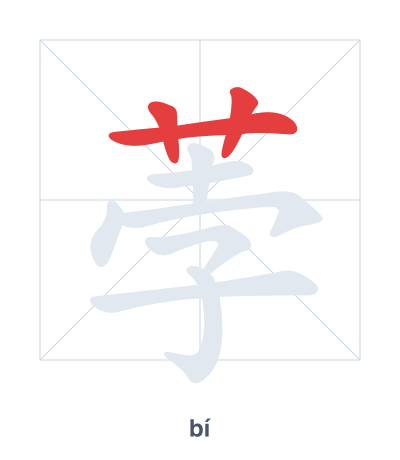
Open Hanzi Writer to see the animated stroke order and practice writing 荸 with real-time feedback.
The character 荸 (bí) is written with 10 strokes. Follow the standard Chinese stroke order: top to bottom, left to right, outside before inside. The radical 艹 is one of its key components.
Practice the correct stroke order with the Hanzi Writer app to see animated stroke-by-stroke guidance with real-time feedback.
荸 means Water chestnut (short for 荸荠).
荸 is a phono-semantic compound: the radical 艹 indicates it's a plant, while 孛 (bèi) provides the pronunciation. The water chestnut is an aquatic grass-like plant with edible corms, so the grass radical links it to the plant kingdom.
💡 Memory Tip: Picture a water chestnut (艹) with a little comet (孛) flying off its tip as you bite into it.
荸荠吃起来很脆。
bí qí chī qǐ lái hěn cuì
Water chestnuts taste very crunchy.
喝点荸荠水吧。
hē diǎn bí qí shuǐ ba
Have some water chestnut water.
这种荸荠糕很甜。
zhè zhǒng bí qí gāo hěn tián
This water chestnut cake is very sweet.
Open Hanzi Writer to see the animated stroke order and practice writing 荸 with real-time feedback.
✨ Animated stroke order · Handwriting recognition · HSK-graded practice · Free to use
荸 has the radical 艹 (grass) on top, which shows it is a plant. The rest is a phonetic part that hints at the pronunciation bí. This structure is common for plant names, like 荸荠 meaning water chestnut.