萄 (táo) means "grape (used in the word for grape)" in Chinese. It has 11 strokes with the radical 艹, and is HSK Level 5.
Rated 4.2/5 in difficulty (advanced).
Harder than 90% of HSK Level 5 characters.
Appears in 3+ common words including 葡萄 (pú táo), 葡萄汁 (pú táo zhī), 葡萄酒 (pú táo jiǔ).
Due to its 11 strokes, Hanzi Writer's error detection shows 萄 requires focused practice — most learners need 10+ attempts for consistent accuracy.
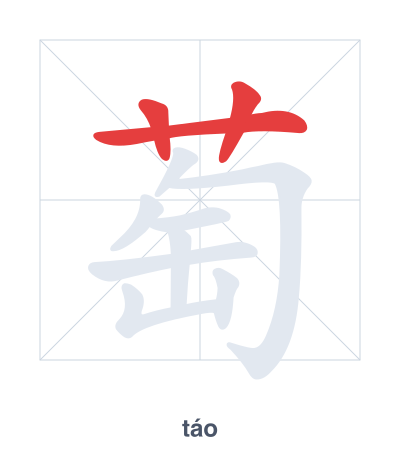
Open Hanzi Writer to see the animated stroke order and practice writing 萄 with real-time feedback.
The character 萄 (táo) is written with 11 strokes. Follow the standard Chinese stroke order: top to bottom, left to right, outside before inside. The radical 艹 is one of its key components.
Practice the correct stroke order with the Hanzi Writer app to see animated stroke-by-stroke guidance with real-time feedback.
萄 means grape (used in the word for grape).
As an HSK Level 5 character, 萄 is an intermediate-level character.
萄 is a compound character where the radical 艹 (grass/plant) indicates it is a type of plant, while the phonetic component 匋 (táo, originally meaning pottery) provides the pronunciation. The character is used specifically in 葡萄 (pú táo, 'grape'), referring to the grapevine and its fruit.
💡 Memory Tip: Picture a grapevine (艹) with clusters of grapes that look like tiny pottery jars (匋) hanging from the leaves.
葡萄非常甜。
pú táo fēi cháng tián
The grapes are extremely sweet.
我想喝葡萄汁。
wǒ xiǎng hē pú táo zhī
I want to drink grape juice.
他不喝葡萄酒。
tā bù hē pú táo jiǔ
He doesn't drink wine.
Open Hanzi Writer to see the animated stroke order and practice writing 萄 with real-time feedback.
✨ Animated stroke order · Handwriting recognition · HSK-graded practice · Free to use
萄 is composed of the radical 艹 (grass) on top and the phonetic component 匋 (táo) below. The grass radical indicates that the character relates to plants, and 匋 provides the pronunciation táo, but the meaning comes from the whole word 葡萄 (grape), which is a transliteration from an ancient language.