赔 (péi) means "to compensate; to lose money" in Chinese. It has 12 strokes with the radical 贝, and is HSK Level 5.
Rated 4.2/5 in difficulty (advanced).
Harder than 93% of HSK Level 5 characters.
Appears in 3+ common words including 赔钱 (péi qián), 赔礼 (péi lǐ), 赔偿 (péi cháng).
Due to its 12 strokes, Hanzi Writer's error detection shows 赔 requires focused practice — most learners need 10+ attempts for consistent accuracy.
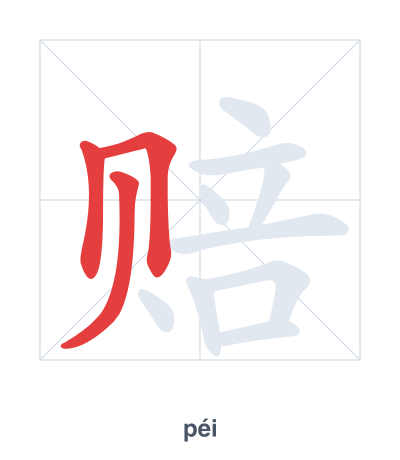
Open Hanzi Writer to see the animated stroke order and practice writing 赔 with real-time feedback.
The character 赔 (péi) is written with 12 strokes. Follow the standard Chinese stroke order: top to bottom, left to right, outside before inside. The radical 贝 is one of its key components.
Practice the correct stroke order with the Hanzi Writer app to see animated stroke-by-stroke guidance with real-time feedback.
赔 means to compensate; to lose money.
As an HSK Level 5 character, 赔 is an intermediate-level character.
赔 combines the radical 贝 (shell/money) with the phonetic component 咅 (póu). In ancient China, shells were used as currency, so 贝 signifies money; the addition of 咅 (which originally depicted a spitting mouth) suggests the action of 'spitting out' or 'losing' money, thus conveying the meanings of compensating for a loss or suffering a financial setback.
💡 Memory Tip: Imagine you have to pay compensation by spitting out coins (贝) from your mouth (咅) because you broke something expensive.
这笔生意赔钱了。
zhè bǐ shēng yì péi qián le
This business deal lost money.
我向你赔礼道歉。
wǒ xiàng nǐ péi lǐ dào qiàn
I offer you my apologies.
他要求对方赔偿。
tā yāo qiú duì fāng péi cháng
He demanded compensation from the other party.
Open Hanzi Writer to see the animated stroke order and practice writing 赔 with real-time feedback.
✨ Animated stroke order · Handwriting recognition · HSK-graded practice · Free to use
赔 is made of the radical 贝 (shell/money) on the left and 咅 on the right. The radical 贝 directly connects to money, which is central to the meanings of compensating or losing money. The right part 咅 originally added a sense of 'adding' or 'accompanying,' so together the character suggests giving money to make up for a loss.