偿 (cháng) means "to repay; to compensate; to fulfill" in Chinese. It has 11 strokes with the radical 亻, and is HSK Level 5.
Rated 3.9/5 in difficulty (challenging).
Harder than 43% of HSK Level 5 characters.
Appears in 3+ common words including 补偿 (bǔ cháng), 偿还 (cháng huán), 有偿 (yǒu cháng).
Due to its 11 strokes, Hanzi Writer's error detection shows 偿 requires focused practice — most learners need 10+ attempts for consistent accuracy.
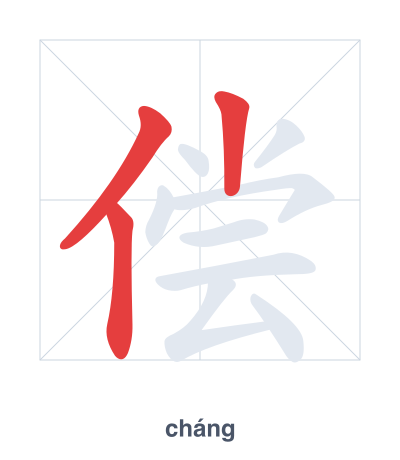
Open Hanzi Writer to see the animated stroke order and practice writing 偿 with real-time feedback.
The character 偿 (cháng) is written with 11 strokes. Follow the standard Chinese stroke order: top to bottom, left to right, outside before inside. The radical 亻 is one of its key components.
Practice the correct stroke order with the Hanzi Writer app to see animated stroke-by-stroke guidance with real-time feedback.
偿 means to repay; to compensate; to fulfill.
As an HSK Level 5 character, 偿 is an intermediate-level character.
The character 偿 combines the person radical 亻(a person acting)with 尝(cháng, meaning 'to taste' and serving as the phonetic component). Together, they suggest a person 'tasting' or experiencing the result of repaying or compensating someone for a debt or wrong.
💡 Memory Tip: Picture a person (亻) tasting (尝) a gold coin to verify it's real before using it to repay a debt.
给你一些补偿。
gěi nǐ yī xiē bǔ cháng
Give you some compensation.
我要偿还这笔钱。
wǒ yào cháng huán zhè bǐ qián
I need to repay this money.
这是有偿服务。
zhè shì yǒu cháng fú wù
This is a paid service.
Open Hanzi Writer to see the animated stroke order and practice writing 偿 with real-time feedback.
✨ Animated stroke order · Handwriting recognition · HSK-graded practice · Free to use
The left side is the radical 亻 (person), indicating the character involves a person. The right side is 尝 (to taste), but here it contributes to the sound and the meaning of fulfilling or compensating. Together, 偿 suggests a person doing something to make up for a loss or obligation, like repaying a debt.