贽 (zhì) means "Gift presented to a superior" in Chinese. It has 10 strokes with the radical 贝.
Rated 4.2/5 in difficulty (advanced).
Appears in 3+ common words including 贽礼 (zhì lǐ), 贽见 (zhì jiàn), 奠贽 (diàn zhì).
Due to its 10 strokes, Hanzi Writer's error detection shows 贽 requires focused practice — most learners need 10+ attempts for consistent accuracy.
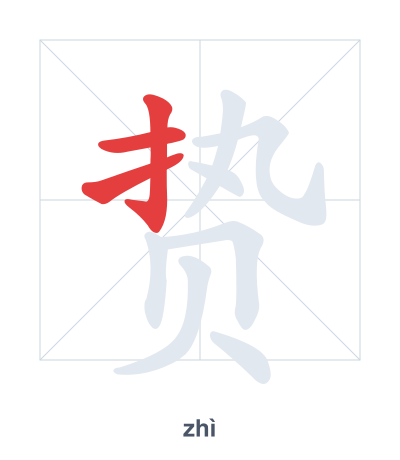
Open Hanzi Writer to see the animated stroke order and practice writing 贽 with real-time feedback.
The character 贽 (zhì) is written with 10 strokes. Follow the standard Chinese stroke order: top to bottom, left to right, outside before inside. The radical 贝 is one of its key components.
Practice the correct stroke order with the Hanzi Writer app to see animated stroke-by-stroke guidance with real-time feedback.
贽 means Gift presented to a superior.
贽 combines 执 (zhí, 'to hold') on top and 贝 (treasure/shell) on bottom. The character visually depicts holding a precious gift, specifically something valuable like shell-money, to present to a superior. This compound structure directly conveys the meaning of a ceremonial gift offered to someone of higher status.
💡 Memory Tip: Picture a nervous official holding (执) a shiny shell (贝) as a tribute to the emperor.
他准备了一份贽礼。
tā zhǔn bèi le yī fèn zhì lǐ
He prepared an introductory gift.
这是他的贽见礼。
zhè shì tā de zhì jiàn lǐ
This is his introductory gift.
奠贽之礼不可废。
diàn zhì zhī lǐ bù kě fèi
The ritual of presenting ceremonial gifts cannot be abandoned.
Open Hanzi Writer to see the animated stroke order and practice writing 贽 with real-time feedback.
✨ Animated stroke order · Handwriting recognition · HSK-graded practice · Free to use
贽 is composed of 执 (zhí, meaning 'to hold' or 'to grasp') on top and 贝 (bèi, meaning 'shell' or 'money') on the bottom. The top part 执 suggests the action of presenting something, while 贝 represents the gift itself. Together, they convey the idea of holding a gift to offer to a superior.