账 (zhàng) means "account; bill; debt" in Chinese. It has 8 strokes with the radical 贝, and is HSK Level 6.
Rated 3.7/5 in difficulty (challenging).
Harder than 35% of HSK Level 6 characters.
Appears in 3+ common words including 结账 (jié zhàng), 账号 (zhàng hào), 记账 (jì zhàng).
Due to its 8 strokes, Hanzi Writer's error detection shows 账 requires focused practice — most learners need 10+ attempts for consistent accuracy.
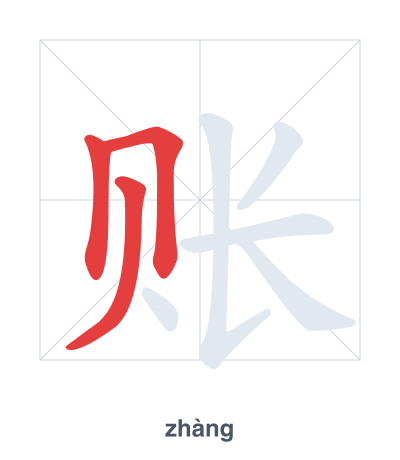
Open Hanzi Writer to see the animated stroke order and practice writing 账 with real-time feedback.
The character 账 (zhàng) is written with 8 strokes. Follow the standard Chinese stroke order: top to bottom, left to right, outside before inside. The radical 贝 is one of its key components.
Practice the correct stroke order with the Hanzi Writer app to see animated stroke-by-stroke guidance with real-time feedback.
账 means account; bill; debt.
As an HSK Level 6 character, 账 is an intermediate-level character.
账 is a compound character combining the radical 贝 (shell, representing money) with 长 (long, growth). This suggests a long record of monetary transactions, like an account or bill that grows over time.
💡 Memory Tip: Imagine a long (长) scroll of shells (贝) listing debts you owe, stretching out like a bill.
服务员,请结账。
fú wù yuán qǐng jié zhàng
Waiter, the bill please.
这是我的银行账号。
zhè shì wǒ de yín háng zhàng hào
This is my bank account number.
我每天都记账。
wǒ měi tiān dōu jì zhàng
I keep track of my accounts every day.
Open Hanzi Writer to see the animated stroke order and practice writing 账 with real-time feedback.
✨ Animated stroke order · Handwriting recognition · HSK-graded practice · Free to use
账 is composed of 贝 (shell, representing money or valuables) on the left and 长 (zhǎng, a phonetic component suggesting the pronunciation zhàng) on the right. The 贝 radical connects the character to financial matters, so together they form the idea of an account or debt.