财 (cái) means "wealth; money; riches" in Chinese. It has 7 strokes with the radical 贝, and is HSK Level 4.
Rated 3.5/5 in difficulty (challenging).
Harder than 36% of HSK Level 4 characters.
Appears in 3+ common words including 财富 (cái fù), 发财 (fā cái), 财产 (cái chǎn).
Due to its 7 strokes, Hanzi Writer's error detection shows 财 requires focused practice — most learners need 10+ attempts for consistent accuracy.
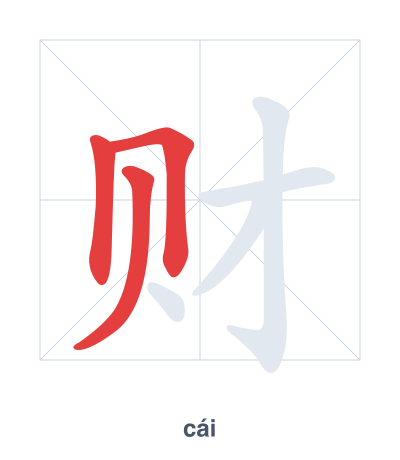
Open Hanzi Writer to see the animated stroke order and practice writing 财 with real-time feedback.
The character 财 (cái) is written with 7 strokes. Follow the standard Chinese stroke order: top to bottom, left to right, outside before inside. The radical 贝 is one of its key components.
Practice the correct stroke order with the Hanzi Writer app to see animated stroke-by-stroke guidance with real-time feedback.
财 means wealth; money; riches.
As an HSK Level 4 character, 财 is an intermediate-level character.
财 is a phono-semantic compound. The left part 贝 (shell) represents ancient currency and thus wealth, while the right part 才 (cái) gives the pronunciation and suggests 'talent' or 'ability'—implying that wealth often comes from skill.
💡 Memory Tip: Imagine a talented person (才) using their ability to collect precious shells (贝), turning their skill into riches.
健康是人生最大的财富。
jiàn kāng shì rén shēng zuì dà de cái fù
Health is the greatest wealth in life.
祝大家新年发大财。
zhù dà jiā xīn nián fā dà cái
Wish everyone great wealth in the New Year.
我们要保护公共财产。
wǒ men yào bǎo hù gōng gòng cái chǎn
We must protect public property.
Open Hanzi Writer to see the animated stroke order and practice writing 财 with real-time feedback.
✨ Animated stroke order · Handwriting recognition · HSK-graded practice · Free to use
The character 财 is made of the radical 贝 (shell) on the left and the phonetic component 才 (cái) on the right. In ancient China, shells were used as money, so 贝 connects to wealth. The right side 才 provides the pronunciation and also hints that talent (才) can lead to wealth.