吏 (lì) means "official; bureaucrat (ancient)" in Chinese. It has 6 strokes with the radical 口, and is HSK Level 7.
Rated 3.2/5 in difficulty (challenging).
Harder than 9% of HSK Level 7 characters.
Appears in 3+ common words including 官吏 (guān lì), 吏治 (lì zhì), 贪官污吏 (tān guān wū lì).
Due to its 6 strokes, Hanzi Writer's error detection shows 吏 requires focused practice — most learners need 10+ attempts for consistent accuracy.
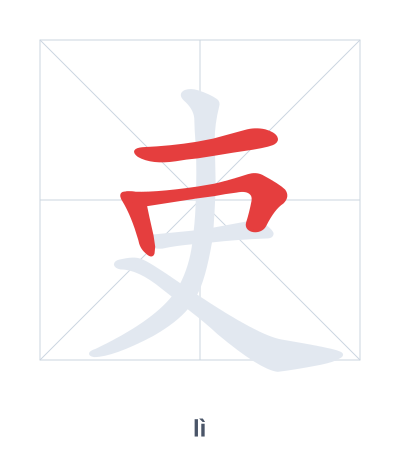
Open Hanzi Writer to see the animated stroke order and practice writing 吏 with real-time feedback.
The character 吏 (lì) is written with 6 strokes. Follow the standard Chinese stroke order: top to bottom, left to right, outside before inside. The radical 口 is one of its key components.
Practice the correct stroke order with the Hanzi Writer app to see animated stroke-by-stroke guidance with real-time feedback.
吏 means official; bureaucrat (ancient).
As an HSK Level 7 character, 吏 is an intermediate-level character.
吏 combines 一 (a horizontal stroke representing authority or a hat) with 史 (a hand holding a tally, meaning 'scribe' or 'historian'). The original character depicted a scribe who records events, but the added stroke elevates the role to a higher-ranked official or bureaucrat in ancient China.
💡 Memory Tip: Picture an ancient official (史) wearing a flat ceremonial hat (the top horizontal stroke 一) as he carries out his duties.
古代的官吏很威风。
gǔ dài de guān lì hěn wēi fēng
Ancient officials were very imposing.
这里的吏治很清明。
zhè lǐ de lì zhì hěn qīng míng
The local administration is honest and clean.
人们讨厌贪官污吏。
rén men tǎo yàn tān guān wū lì
People detest corrupt officials.
Open Hanzi Writer to see the animated stroke order and practice writing 吏 with real-time feedback.
✨ Animated stroke order · Handwriting recognition · HSK-graded practice · Free to use
吏 is composed of three parts: a horizontal line (一) on top, a mouth (口) in the middle, and a crossing stroke (乂) at the bottom. The mouth suggests speaking or giving orders, and the crossing may represent an authoritative action, so together it symbolizes an official who issues commands.