污 (wū) means "Dirty / Filth" in Chinese. It has 6 strokes with the radical 氵, and is HSK Level 5.
Rated 3.2/5 in difficulty (challenging).
Harder than 16% of HSK Level 5 characters.
Appears in 3+ common words including 污染 (wū rǎn), 污垢 (wū gòu), 污水 (wū shuǐ).
Due to its 6 strokes, Hanzi Writer's error detection shows 污 requires focused practice — most learners need 10+ attempts for consistent accuracy.
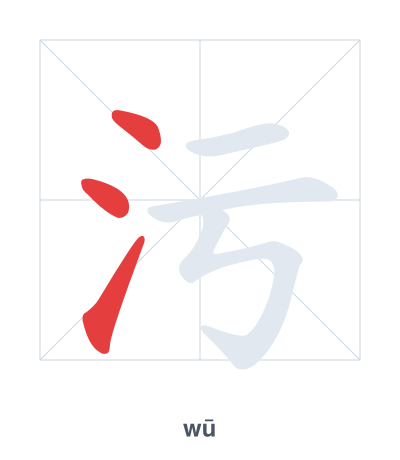
Open Hanzi Writer to see the animated stroke order and practice writing 污 with real-time feedback.
The character 污 (wū) is written with 6 strokes. Follow the standard Chinese stroke order: top to bottom, left to right, outside before inside. The radical 氵 is one of its key components.
Practice the correct stroke order with the Hanzi Writer app to see animated stroke-by-stroke guidance with real-time feedback.
污 means Dirty / Filth.
As an HSK Level 5 character, 污 is an intermediate-level character.
The character 污 combines the water radical 氵 with 亏, which originally depicted a curved pit or hollow. Together, they represent stagnant water collecting in a depression, symbolizing dirtiness or filth.
💡 Memory Tip: Picture a drop of water (氵) falling into a crooked, muddy hole shaped like a bent hook (亏), instantly turning into a puddle of filth.
我们要减少环境污染。
wǒ men yào jiǎn shǎo huán jìng wū rǎn
We must reduce environmental pollution.
衣服上有很多污垢。
yī fú shàng yǒu hěn duō wū gòu
There is a lot of dirt on the clothes.
这里不能排放污水。
zhè lǐ bù néng pái fàng wū shuǐ
Sewage cannot be discharged here.
Open Hanzi Writer to see the animated stroke order and practice writing 污 with real-time feedback.
✨ Animated stroke order · Handwriting recognition · HSK-graded practice · Free to use
污 consists of the water radical 氵 on the left and 亏 (kuī, a hollow or deficient shape) on the right. The water radical suggests liquid, while 亏 hints at something lacking or spoiled, together conveying the idea of dirty or contaminated water.