贪 (tān) means "Greedy / To covet" in Chinese. It has 8 strokes with the radical 贝, and is HSK Level 7.
Rated 3.7/5 in difficulty (challenging).
Harder than 31% of HSK Level 7 characters.
Appears in 3+ common words including 贪吃 (tān chī), 贪玩 (tān wán), 贪心 (tān xīn).
Due to its 8 strokes, Hanzi Writer's error detection shows 贪 requires focused practice — most learners need 10+ attempts for consistent accuracy.
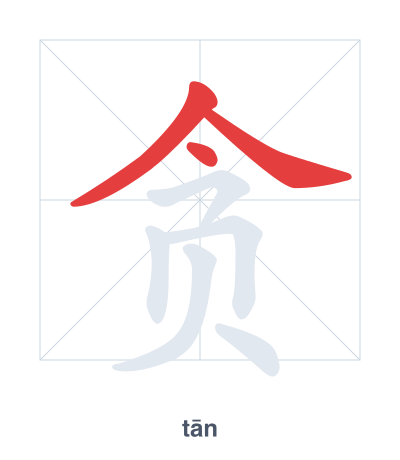
Open Hanzi Writer to see the animated stroke order and practice writing 贪 with real-time feedback.
The character 贪 (tān) is written with 8 strokes. Follow the standard Chinese stroke order: top to bottom, left to right, outside before inside. The radical 贝 is one of its key components.
Practice the correct stroke order with the Hanzi Writer app to see animated stroke-by-stroke guidance with real-time feedback.
贪 means Greedy / To covet.
As an HSK Level 7 character, 贪 is an intermediate-level character.
贪 combines the radical 贝 (shell, representing money/wealth) with 今 (meaning 'now' or 'present'), which also gives the pronunciation tān. The character suggests a person who is so focused on immediate gain (今) that they covet wealth (贝) excessively, hence 'greedy.'
💡 Memory Tip: Picture a greedy person grabbing a shell (贝) with one hand and a clock (今, like a ticking timer) with the other, never satisfied with what they have now.
小猫非常贪吃。
xiǎo māo fēi cháng tān chī
The kitten is very greedy.
弟弟总是很贪玩。
dì di zǒng shì hěn tān wán
Little brother is always very playful.
做人不能太贪心。
zuò rén bù néng tài tān xīn
One shouldn't be too greedy.
Open Hanzi Writer to see the animated stroke order and practice writing 贪 with real-time feedback.
✨ Animated stroke order · Handwriting recognition · HSK-graded practice · Free to use
贪 is made of two parts: the top is 今 (jīn, meaning 'today') and the bottom is 贝 (bèi, meaning 'shell' or 'money'). The bottom part 贝 shows that greed is connected to wealth, while the top part gives the character its sound.