治 (zhì) means "To treat or govern" in Chinese. It has 8 strokes with the radical 氵, and is HSK Level 4.
Rated 3.7/5 in difficulty (challenging).
Harder than 47% of HSK Level 4 characters.
Appears in 3+ common words including 治病 (zhì bìng), 治理 (zhì lǐ), 治安 (zhì ān).
Due to its 8 strokes, Hanzi Writer's error detection shows 治 requires focused practice — most learners need 10+ attempts for consistent accuracy.
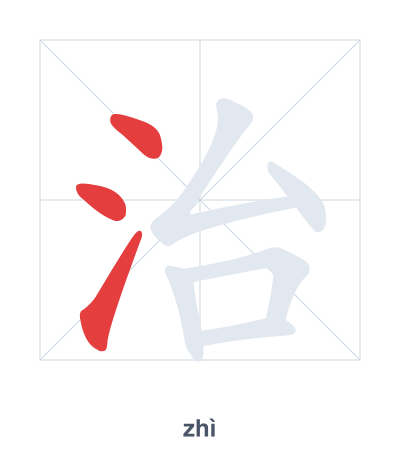
Open Hanzi Writer to see the animated stroke order and practice writing 治 with real-time feedback.
The character 治 (zhì) is written with 8 strokes. Follow the standard Chinese stroke order: top to bottom, left to right, outside before inside. The radical 氵 is one of its key components.
Practice the correct stroke order with the Hanzi Writer app to see animated stroke-by-stroke guidance with real-time feedback.
治 means To treat or govern.
As an HSK Level 4 character, 治 is an intermediate-level character.
治 combines the water radical 氵 with 台 (a raised platform), originally referring to managing water flow by building embankments or canals, which later extended to mean 'to govern' or 'to treat' in a broader sense.
💡 Memory Tip: Imagine a doctor (台) standing by a river (氵) to control the water flow, symbolizing how they 'treat' both water and patients.
这种药能治病。
zhè zhǒng yào néng zhì bìng
This medicine can cure illnesses.
政府正在治理污染。
zhèng fǔ zhèng zài zhì lǐ wū rǎn
The government is tackling pollution.
这里的治安非常好。
zhè lǐ de zhì ān fēi cháng hǎo
The public security here is very good.
Open Hanzi Writer to see the animated stroke order and practice writing 治 with real-time feedback.
✨ Animated stroke order · Handwriting recognition · HSK-graded practice · Free to use
治 is composed of the water radical 氵 on the left and 台 on the right. The water radical originally hints at controlling water flows, which was an early form of governance. Together, the character conveys the idea of bringing order or treatment, whether for a disease or a society.