雷 (léi) means "Thunder" in Chinese. It has 13 strokes with the radical 雨, and is HSK Level 4.
Rated 4.2/5 in difficulty (advanced).
Harder than 99% of HSK Level 4 characters.
Appears in 3+ common words including 打雷 (dǎ léi), 雷雨 (léi yǔ), 地雷 (dì léi).
Due to its 13 strokes, Hanzi Writer's error detection shows 雷 requires focused practice — most learners need 10+ attempts for consistent accuracy.
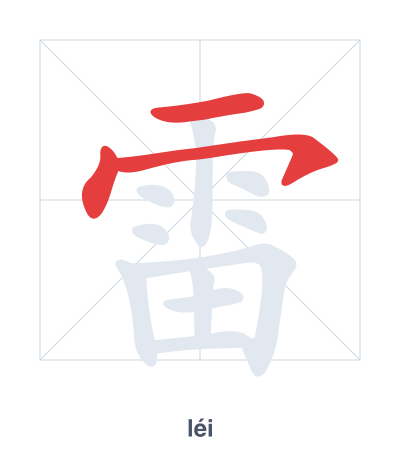
Open Hanzi Writer to see the animated stroke order and practice writing 雷 with real-time feedback.
The character 雷 (léi) is written with 13 strokes. Follow the standard Chinese stroke order: top to bottom, left to right, outside before inside. The radical 雨 is one of its key components.
Practice the correct stroke order with the Hanzi Writer app to see animated stroke-by-stroke guidance with real-time feedback.
雷 means Thunder.
As an HSK Level 4 character, 雷 is an intermediate-level character.
雷 combines 雨 (rain) on top of 田 (field), reflecting ancient Chinese belief that thunder accompanies rainstorms and rumbles across the fields. In older forms, it sometimes included multiple circles or 畾 to suggest the rolling sound of thunder, but the modern simplified version uses 田 as a compact symbol for the earth that receives the thunderclap.
💡 Memory Tip: Imagine a farmer in a rainy field (田 under 雨) suddenly startled by a deafening clap of thunder right above him.
外面正在打雷。
wài miàn zhèng zài dǎ léi
It is thundering outside.
下午会有雷雨。
xià wǔ huì yǒu léi yǔ
There will be thunderstorms this afternoon.
这里有很多地雷。
zhè lǐ yǒu hěn duō dì léi
There are many landmines here.
Open Hanzi Writer to see the animated stroke order and practice writing 雷 with real-time feedback.
✨ Animated stroke order · Handwriting recognition · HSK-graded practice · Free to use
雷 is made of two parts: the radical 雨 (rain) on top and 田 (field) below. The rain over a field suggests a thunderstorm, linking directly to the meaning "thunder."